

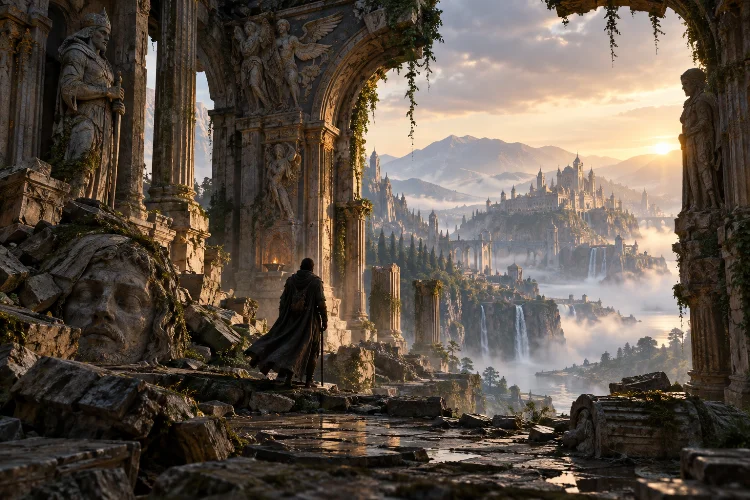
Some fantasy worlds feel as if they appeared five minutes before the movie started. Others give the strange impression that thousands of years have already passed before the first character walks on screen.
The difference is rarely just budget or visual effects.
Understanding how history and myth create depth in fantasy cinematic worlds means looking at everything that exists behind the immediate plot: forgotten wars, ruined kingdoms, ancient religions, legendary heroes, disputed memories, old songs, sacred objects, and stories that characters inherited from earlier generations.
These layers give fictional settings something similar to cultural memory.
Middle-earth feels enormous partly because the characters constantly encounter traces of events older than themselves.
Pan’s Labyrinth combines fairy-tale traditions with the real political trauma of Francoist Spain, while Princess Mononoke uses a mythic landscape shaped by historical tensions between nature, technology, and human expansion.
Great fantasy cinema does not simply create a present.
It creates the feeling of a past that still influences what happens now.
History Makes the Present Feel Like a Consequence
The simplest way to add depth to an imaginary world is to give its present a cause.
Kingdoms should not exist simply because the screenplay needs kings. Borders, alliances, rivalries, religions, and social institutions become more convincing when audiences can sense how earlier events created them.
This is where fictional history becomes useful.
Perhaps two kingdoms fought a war generations ago. The war may be over, yet descendants still distrust each other. An old empire may have collapsed, leaving roads, fortresses, languages, and political ideas behind.
The past continues shaping the present.
Cambridge scholarship on historical fantasy highlights the close relationship between fantasy and historical fiction: both require the construction of worlds with their own customs, social tensions, and recognizable historical conditions.
For filmmakers, the practical lesson is important.
Do not invent histroy simply to fill a timeline. Invent consequences.
If an ancient event supposedly mattered, something in the current world should still carry its effects.
Ruins Turn Backstory Into Something Audiences Can See
A ruined city can communicate hundreds of years of history without a narrator explaining anything.
Ruins suggest that people once lived differently.
Broken statues imply forgotten rulers. Abandoned roads suggest collapsed trade networks. Enormous fortifications may reveal wars that happened long before the protagonists were born.
Middle-earth uses this technique constantly.
Christopher Tolkien described the world of The Lord of the Rings as being especially rich in its past, filled with ancient roads, ruined cities, battlefields, monumental stone works, and references to lands that no longer exist.
That makes exploration feel archaeological.
Characters are not moving through empty fantasy scenery. They are walking across the remains of previous ages.
Peter Jackson’s films strengthen that impression visually. Moria, Weathertop, ruined monuments, abandoned fortifications, and ancient statues make viewers feel that every landscape contains another story underneath the current one.
That is environmental worldbuilding at its strongest.
Myth Explains How Cultures Understand Their World
History asks what happened.
Myth asks what people believe happened – and what those stories mean.
That distinction is extremely useful in fantasy cinema.
A civilisation may tell stories about its creation, legendary kings, divine ancestors, monsters, sacred mountains, or supernatural catastrophes. Whether every detail is objectively true matters less than the effect those stories have on the culture.
Myths can justify rulers, inspire warriors, create religious rituals, or explain why one community considers a particular place sacred.
J.R.R. Tolkien famously developed a huge interconnected legendarium around Middle-earth, extending from creation myths to heroic legends and later historical ages. His work on this mytholgical background began decades before The Lord of the Rings was completed.
The result is depth through inheritance.
Characters feel as though they live inside stories that existed before them.
That makes the fictional world seem culturally mature rather than freshly invented.
Legends Become More Interesting When Their Meaning Changes
Real cultures rarely preserve stories perfectly.
Legends change.
One generation turns a military leader into a hero. Another questions whether that person deserved admiration. Different regions may tell contradictory versions of the same event.
Fantasy worlds become much richer when filmmakers allow the same process.
Arthurian mythology demonstrates how adaptable legends can become. The stories of Arthur, Merlin, Excalibur, the Round Table, and the Grail have been repeatedly reshaped across centuries and different forms of cinema.
David Lowery’s The Green Knight, for example, reinterprets the 14th-century Sir Gawain and the Green Knight as a strange psychological journey about courage, mortality, and identity.
That flexibility can exist inside fictional worlds too.
A ruler may believe an old legend literally, while scholars interpret it symbolically. Ordinary citizens may know only a simplified version.
Now mythology becomes socially active.
It creates disagreement rather than functioning as neutral background information.
Historical Trauma Gives Fantasy Conflict Emotional Weight
Not every past should be glorious.
Wars, conquest, environmental destruction, persecution, political collapse, and forced migration can leave collective wounds that remain visible generations later.
Fantasy movies can use these memories to explain current behavior.
A society that survived invasion may become suspicious of foreigners. A kingdom once destroyed by magic might regulate supernatural power aggressively. A community displaced from its homeland could preserve rituals and stories designed to maintain identity.
Pan’s Labyrinth demonstrates how powerful the relationship between history and fantasy can become.
Guillermo del Toro sets the film in Francoist Spain in 1944 and intertwines political violence with Ofelia’s fairy-tale world.
BFI describes the film as a merging of real historical turmoil and fantasy, while del Toro himself discussed using fairy-tale structures to explore choice against the authoritarian logic of fascism.
The fantasy therefore does not escape history.
It interprets it.
That gives both worlds greater emotional force.
Myth Can Carry Ecological Memory
Fantasy mythology does not have to revolve around kings and gods.
It can explain humanity’s relationship with nature.
Princess Mononoke is a particularly strong example.
Hayao Miyazaki drew inspiration from Japan’s Muromachi period while creating a world where animal gods, forest spirits, iron production, warfare, and expanding human settlements collide.
BFI notes how the film combines historical influences with supernatural beings while exploring the destruction caused by human technological expansion.
The mythic creatures are not simply monsters.
They represent an older order of the world.
When forests disappear, something cultural and spiritual disappears with them.
This gives geography memory.
A sacred forest is no longer merely a beautiful location. It becomes evidence of a relationship between people, nature, and belief that has existed for generations.
That kind of myth makes worldbuilding feel emotionally connected to the landscape.
Historical Objects Can Carry Entire Stories
Fantasy cinema often uses objects as compressed history.
Swords, crowns, rings, books, statues, broken armor, family heirlooms, and magical artifacts can carry stories across generations.
The object itself becomes less important than what people remember about it.
Consider a legendary sword.
One group might see it as proof of legitimate kingship. Another remembers the ruler who used it during a brutal conquest. Someone else believes it possesses supernatural power.
Suddenly one object contains politics, myth, religion, and disputed history.
This is much more effective than creating magical artifacts with no cultural context.
The Lord of the Rings uses the One Ring in exactly this larger historical sense.
The opening of Peter Jackson’s The Fellowship of the Ring compresses thousands of years of Middle-earth history to establish the Ring’s earlier owners, Sauron’s defeat, and the consequences of Isildur’s decisions.
The object therefore arrives in Frodo’s hands already carrying history.
It does not begin becoming important when the movie begins.
Cultural Memory Should Appear in Everyday Behavior
Deep history becomes most convincing when ordinary characters behave as if they grew up knowing it.
They may sing songs about old heroes, use expressions derived from forgotten events, celebrate victories, mourn historical disasters, or avoid places believed to be cursed.
Nobody needs to stop and explain everything.
In fact, casual references can be more effective.
A character might mention an ancient king in the same way people today reference famous historical figures. A soldier may wear a symbol whose original meaning has partly been forgotten.
This creates the impression that knowledge exists beyond what the audience receives.
Tolkien’s approach to the Secondary World is useful here. His conception of fantasy emphasized building an internally convincing imagined reality capable of sustaining belief, rather than merely presenting isolated supernatural events.
The important word is continuity.
A beliveable civilisation remembers things.
Even when those memories are incomplete.
Contradictions Make Fictional History Feel Real
One overlooked worldbuilding technique is uncertainty.
Fantasy filmmakers sometimes explain the past too perfectly.
Every date is known. Every myth has one correct interpretation. Everyone agrees about ancient wars.
Real historical memory rarely works that way.
Records disappear. Victors rewrite events. Religious traditions transform stories. Different communities remember the same conflict differently.
Fantasy worlds become deeper when the audience realizes that history itself may be unreliable.
Maybe an ancient hero was actually a conqueror.
Perhaps a supposedly evil civilization was defeated by people who later controlled the historical record.
A prophecy may have been translated incorrectly. A legendary monster might once have been an ordinary ruler whose story changed over centuries.
This gives audiences something to investigate.
The past stops being an encyclopedia and becomes a mystery.
That uncertainty can also create excellent plot material because characters may act on stories that were never completely true.
The Past Should Change What Characters Choose
Ultimately, history and mythology matter only when they affect the story.
A thousand pages of fictional lore mean very little if characters could behave exactly the same without knowing any of it.
Strong worldbuilding connects memory to decisions.
A character seeks revenge because their family remembers an old massacre. A ruler refuses an alliance because of an earlier betrayal. A hero enters a forbidden place because a childhood legend suggests something valuable is hidden there.
The past creates motivation.
This is why fantasy works so well as a genre for exploring history and tradition.
Matthew Sangster’s An Introduction to Fantasy emphasizes fantasy’s engagement with histories, cultural traditions, beliefs, and the processes through which imagined worlds develop and question them.
When characters inherit stories, they also inherit expectations.
Some accept them.
Some reinterpret them.
Others decide that the only way forward is to break with what has always been remebered.
That tension between inheritance and change is often where fantasy becomes most interesting.
History and myth create depth in fantasy cinematic worlds because they make the present feel inherited rather than newly invented.
Ruins reveal lost societies, myths preserve cultural beliefs, artifacts carry memory, and old conflicts continue shaping political and personal decisions.
The strongest fantasy films also avoid making the past completely objective. Legends evolve, communities disagree, historical trauma leaves scars, and supposedly sacred stories can be questioned by later generations.
That complexity creates the illusion of time.
Next time you watch a fantasy movie, look beyond the immediate adventure. Notice the ruined structures, old songs, inherited symbols, legendary names, and stories characters assume everyone already knows.
Those small traces often reveal something much larger: a world that seems to remember what happened before the camera arrived.
