

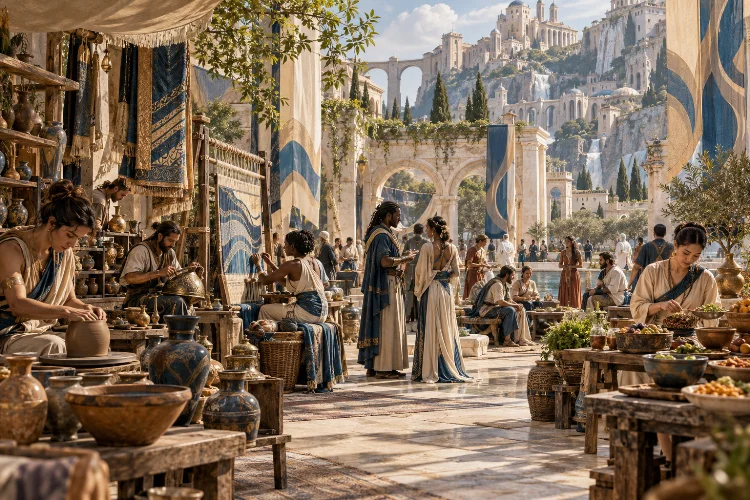
A fantasy civilisation can have spectacular palaces, elaborate costumes, and thousands of years of fictional history yet still feel strangely artificial. The problem is often simple: it looks like a culture, but it does not behave like one.
Real cultures are systems. Beliefs influence laws, geography changes food, resources shape technology, family structures affect inheritance, and historical conflicts continue influencing how different groups see each other.
That is why advanced cultural design for believable fantasy movie civilisations involves much more than creating an attractive visual identity.
Filmmakers need to imagine how people worship, trade, marry, govern, celebrate, argue, dress, remember the past, and understand their place within society.
Movies such as Black Panther and Dune demonstrate how these layers can make invented communities feel much larger than the scenes audiences actually see.
The goal is not to explain every cultural detail. It is to create enough connected evidence that viewers naturally assume an entire civilisation exists beyond the camera.
Start With Cultural Values Before Visual Style
Many fictional societies are designed backward.
Creators begin with impressive clothing, unusual buildings, and recognizable visual motifs, then attempt to invent a culture that explains them.
A stronger approach starts with values.
Ask what the civilisation admires. Is loyalty more important than individuality? Does society value military courage, intellectual achievement, family reputation, religious devotion, hospitality, wealth, or harmony with nature?
Those values should influence behavior.
A culture that considers hospitality sacred may have elaborate traditions surrounding visitors. A society obsessed with ancestry might organize political legitimacy around family records and inherited titles.
Fantasy scholar Matthew Sangster notes that language and imagined cultures are closely connected because the words used to describe societies also help construct their systems of value.
Once the values are clear, visual choices become easier because costumes, spaces, ceremonies, and institutions can grow from the same foundation.
Build Social Hierarchies Into Everyday Life
A political system should affect more than scenes involving kings and councils.
Social structure changes ordinary behavior.
Who speaks first during a meeting? Who sits closest to the ruler? Can ordinary citizens challenge someone from a higher class? Does wealth create status, or does ancestry matter more?
These questions make an imagined heirachy visible without requiring characters to explain it.
Black Panther handles this especially well.
Wakanda contains several communities with distinct roles and traditions rather than presenting the country as one culturally identical population.
Costume designer Ruth Carter used specific colors and visual identities for groups such as the River Tribe, Border Tribe, royal community, and Jabari.
That differentiation suggests a larger social system.
The audience begins understanding that Wakandan identity contains regional and political layers, just as cultures in the real world contain class, local, occupational, religious, and family identities.
Use Rituals as Cultural Storytelling Shortcuts
Rituals are extremely efficient worldbuilding tools.
A ceremony can communicate religion, political authority, gender roles, social hierarchy, history, and family relationships within a few minutes.
Consider a coronation.
Who places the crown on the ruler? Where does the ceremony happen? Can anyone challenge succession? Which objects are sacred? Who watches from the best position?
Every choice communicates cultural information.
In Black Panther, tradition remains deeply connected to Wakanda’s futuristic development.
The filmmakers deliberately imagined a technologically advanced civilisation that had retained centuries-old monuments, rituals, and spiritual traditions rather than replacing them with generic futurism.
That contrast makes the society more convincing.
Technology changes quickly. Cultural memory often changes much more slowly.
Strong fantasy societies contain both.
Let Environment Shape Material Culture
Culture does not develop in empty space.
Climate, natural resources, geography, animals, available materials, and transportation all influence how people live.
This is particularly obvious in Dune.
Fremen civilisation is shaped by extreme water scarcity. Clothing, survival techniques, settlements, social behavior, and attitudes toward water make sense because they developed inside the desert environment of Arrakis.
Denis Villeneuve has emphasized Frank Herbert’s attention to ecosystems and the tiny details of Fremen desert survival, while also explaining that a film can only offer glimpses of that enormous cultural system.
That is an important filmmaking lesson.
Audiences do not need a complete anthropological manual.
They need consistant evidence.
If a civilisation lives in a frozen landscape, its food preservation, housing, clothing, transportation, and festivals should probably reflect cold weather. If metal is extremely rare, ordinary citizens should not casually own metal tools.
Environment creates constraints, and constraints create culture.
Make Language and Naming Culturally Coherent
Random fantasy names can make a world feel artificial surprisingly quickly.
Names should sound as though they developed inside related linguistic traditions.
People from the same region may share sounds, titles, family-name structures, or naming conventions. Neighboring cultures might borrow words from each other, while politically isolated societies could develop very different terminology.
Tolkien remains one of the strongest examples of this approach.
His invented languages did not simply decorate Middle-earth. Tolkien developed fictional linguistic histories in which languages changed, separated, and influenced the mythology itself.
The Tolkien Estate notes that his languages and legends were deeply interconnected, with linguistic development sometimes shaping events and peoples within the fictional world.
Tolkien even believed that coherent naming helped create an “illusion of historicity” within his stories.
A filmmaker does not need to invent full grammar systems.
Even simple consistency helps.
Titles, greetings, curses, place names, religious expressions, and family names can quietly establish cultural boundaries.
Architecture and Costume Should Function as Cultural Evidence
Production design becomes much stronger when objects tell audiences how people live.
A throne room is not simply a beautiful interior. Its layout can show who has access to power.
A house can reveal whether privacy matters within a society. A marketplace can suggest trade networks, wealth distribution, and food culture.
Costume works the same way.
Clothing should communicate occupation, status, environment, tradition, technology, and practical needs.
The designers of Wakanda intentionally combined traditional influences with futuristic technology instead of treating those two ideas as opposites.
Production designer Hannah Beachler researched architecture across several African regions, while Ruth Carter drew on multiple cultural references to create distinct but connected visual identities.
The result received major industry recognition: Black Panther won both Production Design and Costume Design at the 2019 Academy Awards.
Good cultural design therefore asks not merely whether something looks interesting.
It asks why people within the fictional society would create it.
Technology and Magic Should Change Institutions
One common fantasy mistake is introducing extraordinary technology or magic without considering its social consequences.
If healing magic exists, healthcare should probably develop differently.
If people can communicate telepathically, espionage and privacy laws might change. If dragons can transport enormous loads, trade networks could look very different from societies dependent on horses.
The same applies to advanced technology.
Wakanda’s vibranium does not simply create superhero equipment. Its existence helps explain the country’s transportation, architecture, weapons, medicine, and economic independence.
The important principle is systemic influence.
Powerful inventions should affect education, military institutions, religion, employment, and goverment structures.
Otherwise, magic or technology feels detached from civilisation.
When supernatural rules reshape ordinary life, they stop looking like special effects and become part of culture.
Give Civilisations Internal Diversity and Historical Tension
No believable civilisation agrees with itself about everything.
People interpret traditions differently.
Older generations may defend customs that younger characters challenge. Rural communities may dislike political elites in the capital. Religious institutions may disagree with merchants, soldiers, scholars, or regional leaders.
This internal variation is essential.
A culture becomes less beliveable when every member wears identical clothing, holds identical values, and agrees about history.
Middle-earth provides a useful example of diversity through language, regional identity, memory, and folklore.
Tolkien developed multiple peoples whose cultural identities were connected to distinct histories and linguistic traditions rather than simply giving each group a different costume.
Historical disagreement makes these divisions even richer.
Perhaps two communities remember the same ancient war differently. One sees a former king as a hero while another considers him a conqueror.
Suddenly history becomes active.
It influences modern politics rather than sitting harmlessly inside a background encyclopedia.
Reveal Culture Through Characters, Not Lectures
Even brilliant worldbuilding can become boring if characters constantly explain it.
Movies work best when culture appears through action.
Someone refusing a meal may reveal a religious rule. A soldier using the wrong honorific might insult an officer. A marriage ceremony can expose family expectations without anyone explaining marriage customs.
This is where cultural design becomes storytelling.
The viewer discovers the society while watching characters navigate it.
Tolkien frequently used a similar technique in his fiction, treating aspects of Hobbit history and customs as things characters already understood rather than pausing to explain every detail.
His casual references helped create the impression of a world larger than the immediate narrative.
Fantasy cinema can do the same visually.
Trust the audience to notice patterns.
The unexplained details often make an invented civilisation feel deeper because viewers sense that the characters know much more about their own culture than the film needs to tell us.
Advanced cultural design for believable fantasy movie civilisations is ultimately about connection. Values should influence institutions, geography should shape material culture, language should reflect history, and rituals should reveal how people understand themselves.
Great fantasy societies also contain disagreement. Different classes, generations, regions, and communities should interpret the same culture in different ways.
That complexity is what turns beautiful production design into believable civilisation.
When watching your next fantasy movie, pay attention to the smaller details. Notice who speaks first, how people greet strangers, what they consider sacred, how they dress for different occasions, and which traditions create conflict.
Those details may seem minor, but together they create one of fantasy cinema’s greatest illusions: the feeling that an entire culture existed long before the movie began.
