

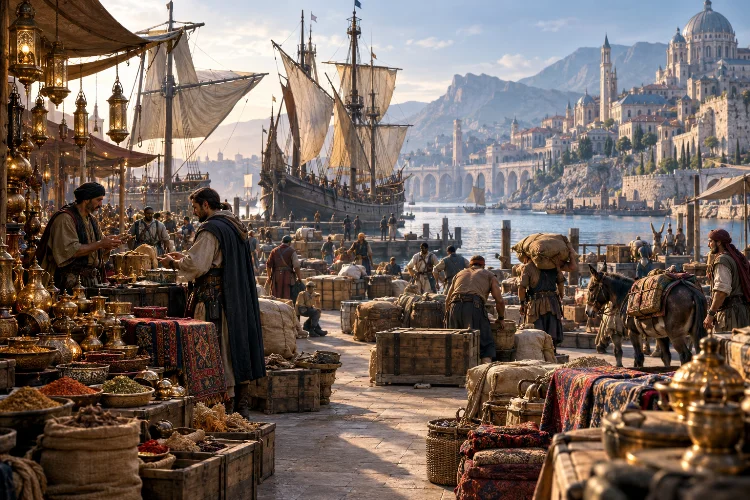
Epic fantasy movies rarely stop for a lecture about interest rates, taxation, labor markets, or supply chains. There are kingdoms to save, monsters to defeat, and ancient prophecies demanding attention.
Yet look beneath the surface and many fantasy worlds are powered by economics.
Understanding advanced economic systems hidden inside epic fantasy movies means asking practical questions that stories often leave in the background.
Who produces food for enormous cities? Who owns mines and farmland? How are armies supplied? What makes one resource valuable, and why does control over it create political power?
Dune revolves around a scarce commodity essential to an interstellar civilization. Black Panther imagines a society transformed by exclusive access to vibranium. The Hobbit eventually turns a heroic adventure into a conflict over ownership of an enormous treasure.
These economic structures matter because they give fantasy conflicts material consequences.
Behind every magical kingdom is usually another story about scarcity, production, ownership, trade, labor, and the distribution of wealth.
Scarcity Is the Foundation of Fantasy Economics
Economics becomes interesting when something valuable is limited.
Fantasy stories understand this surprisingly well.
A magical mineral may exist in only one mountain. A particular plant might grow in a single kingdom. Dragons may guard treasure accumulated over centuries. Water itself can become politically important in a hostile landscape.
Dune provides one of the clearest examples.
Arrakis is the only source of melange, or spice, a substance essential to the wider imperial system and space travel. The BFI’s description of Villeneuve’s film specifically identifies Arrakis as the unique source of this crucial commodity and presents spice mining as central to the conflict surrounding House Atreides.
That creates an economy based on extreme scaricity.
Arrakis is geographically harsh, but economically priceless. Whoever controls production gains influence far beyond the planet itself.
For fantasy worldbuilders, this is a powerful principle: do not simply invent valuable resources. Decide why they are scarce, who extracts them, and what happens when access is interrupted.
Resources Connect Economic Power to Political Power
Rare materials become even more interesting when they transform entire societies.
Wakanda’s vibranium is a good example.
Marvel’s own discussion of the film’s production design explains that Wakanda’s access to vibranium enables extraordinary technological development and enormous wealth.
The material is therefore not merely something used to create Black Panther’s suit; it sits underneath transportation, urban development, military capability, and national power.
This creates an economic advantage similar to a resource monopoly.
Other countries cannot easily reproduce Wakanda’s development because they do not possess the same material foundation.
The interesting question then becomes political.
Should Wakanda trade its resource? Keep it hidden? Share its technology? Protect its monopoly?
Suddenly an imaginary metal produces debates about economic isolation, inequality, technological transfer, and international responsibility.
That is sophisticated worldbuilding because the resource changes institutions rather than functioning as a convenient magical object.
Trade Routes Reveal Which Places Actually Matter
Wealth is not created only by owning resources.
Movement matters too.
A city positioned near an important harbor, river crossing, mountain pass, or caravan route can become wealthy simply because goods repeatedly move through it.
Fantasy films often show spectacular capital cities without explaining why those cities became important. Stronger worldbuilding gives settlements an economic reason to exist.
If grain travels from one region to another, roads become strategic. If magical metals come from distant mountains, merchants and transport networks become essential.
Those connections create interdependance between regions.
One kingdom may produce food while another supplies iron. Coastal cities might depend on inland markets, while isolated fortresses require expensive supply routes.
This also generates storytelling opportunities.
Destroying a bridge can become economically more devastating than destroying a castle. Blocking a port may weaken an enemy without fighting its army directly.
Once trade networks exist, geography starts producing political consequences.
Labor Explains Who Pays for Fantasy Grandeur
Fantasy movies love enormous castles.
Someone still had to build them.
This simple observation reveals a frequently overlooked part of fictional economies: labor.
Who farms the fields, mines the metals, manufactures weapons, constructs roads, cares for animals, produces clothing, and transports food?
A believable fantasy economy needs some relationship between elites and workers.
Maybe farmers owe part of their harvest to a noble family. Skilled craftsmen could belong to guilds. Mining communities might work under royal monopolies. Magical specialists may charge high prices because their abilities are rare.
These systems also create social classes.
A society’s economic structure often explains why some characters possess enormous wealth while others have almost none.
Cambridge scholarship on literature and economics emphasizes that fictional narratives have long explored subjects such as industrial expansion, markets, wealth, financial risk, inequality, and the social consequences produced by economic systems.
Fantasy can do the same.
The castle is much more interesting once we ask who provided the labor that made it possible.
Taxation and Tribute Keep Kingdoms Running
Kings need money.
So do councils, temples, armies, roads, fortifications, and royal households.
Yet fantasy governments are often treated as though crowns somehow generate unlimited financial resources.
A more convincing system asks how the goverment collects wealth.
Farmers may pay taxes through crops instead of coins. Conquered regions could send annual tribute. Merchants might pay customs duties when entering cities. Mining operations may owe a percentage of production to the crown.
These choices affect politics.
Heavy taxation can create rebellion. Low taxes may reduce military capacity. Powerful nobles might resist paying the central government, weakening the kingdom’s ability to respond to crises.
The Shire offers a quieter example of political-economic worldbuilding. Tolkien described it as former royal farmland granted as a fief before the king’s authority gradually disappeared, leaving behind an ordered rural society that continued operating largely on its own.
Even peaceful fantasy communities therefore have histories of property, authority, and land organization underneath everyday life.
War Is Also an Economic System
Epic fantasy battles are expensive – even when the movie never mentions money.
Armies need food, weapons, horses, armor, transport, replacement equipment, and places to sleep.
A force of thousands cannot simply walk endlessly across a continent without supply.
That means logistical capacity is part of military power.
A wealthy kingdom may be able to replace lost weapons quickly. A poor region could have excellent soldiers but struggle to feed them during a long campaign.
Roads and infrastrcture become strategic assets.
This is why sieges are economically interesting. A defender may have enormous walls but still lose once food disappears. An invading army can also collapse if its supply line becomes too long.
Good fantasy warfare therefore depends on more than battlefield courage.
The strongest military may be the society capable of producing, storing, transporting, and replacing resources faster than its opponents.
When filmmakers acknowledge even a small part of this system, battles immediately feel more believable.
The Hobbit Turns Treasure Into an Economic Conflict
Dragons love gold, but The Hobbit goes further than simply treating treasure as a reward.
Smaug’s hoard creates competing claims.
Thorin and the dwarves see the treasure as their inheritance. Bard and the people affected by Smaug have their own claims. Other groups become involved once the dragon is gone.
The Tolkien Estate’s discussion of The Hobbit notes that the story’s true climax develops through the conflict over Smaug’s treasure, which draws former friends and enemies toward a major battle over ownership of the hoard.
That makes treasure structurally important.
Removing Smaug does not solve the economic problem. In fact, his death releases enormous wealth back into circulation and immediately creates disagreement about ownership.
The situation resembles a sudden resource windfall.
Who legally owns the wealth? Who suffered because it was taken? Who deserves compensation? Does ancestral ownership override present need?
These questions make the final conflict more complicated than heroes simply defeating a monster.
Wealth Does Not Matter Until Someone Can Use It
A mountain filled with gold sounds incredibly wealthy.
But wealth locked permanently underground has limited economic usefulness.
This distinction between possessing value and circulating value is useful when analyzing fantasy economies.
Smaug accumulates treasure but does not build roads, employ workers, invest in trade, or purchase goods. Economically, much of the hoard is removed from circulation.
Once that wealth becomes available again, behavior changes rapidly.
This illustrates an important principle: economic power depends not only on what exists but on who controls it and what they can do with it.
The same applies to magical resources.
A rare mineral hidden beneath inaccessible mountains may have enormous theoretical value. Its practical value depends on mining technology, labor, transportation, security, and demand.
Fantasy becomes much deeper when resources require systems rather than magically turning into prosperity.
Isolation Creates Different Economic Models
Wakanda presents another interesting possibility: a wealthy society that deliberately limits external commerical relationships.
Marvel describes Wakanda as technologically advanced yet largely hidden and not deeply engaged in ordinary trade with the outside world.
That raises questions about economic self-sufficiency.
A highly isolated country must produce most essential goods internally or possess substitutes for things normally imported.
This affects agriculture, manufacturing, energy, education, and technology.
Isolation also protects domestic resources from foreign competition or exploitation, but it can create political tension when outsiders need something the country possesses.
In Black Panther, that economic independence becomes part of a larger moral argument about whether national prosperity creates responsibilities beyond national borders.
Economics therefore becomes character conflict and political philosophy at the same time.
Economic Systems Make Fantasy Conflicts More Believable
Fantasy does not need spreadsheets to feel economically coherent.
Audiences simply need to sense cause and effect.
If a kingdom becomes rich, there should be a reason. If an army is enormous, something must support it. If one resource can change civilization, control over that resource should create competition.
Cambridge’s work on speculative fiction and economics notes that imagined worlds can function as both blueprints and critiques of economic arrangements, allowing fiction to experiment with different systems of production, property, and social organization.
Fantasy is particularly good at this because its economies do not have to copy ours exactly.
A magical society could use gift exchange instead of currency. Another might organize land communally. A kingdom could base status on control of dragons rather than ownership of gold.
What matters is consistency.
Once the rules exist, characters should have to live with their consequences.
Advanced economic systems hidden inside epic fantasy movies reveal that the genre is often driven by much more than magic and mythology.
Scarce resources create competition. Trade routes connect distant kingdoms, labor supports royal wealth, taxes finance governments, and logistics determine whether armies can actually fight.
Films such as Dune, Black Panther, and The Hobbit become richer when viewed through these economic relationships.
The most convincing fantasy worlds do not need to explain every transaction. They simply show enough consequences to suggest that production, ownership, exchange, and scarcity continue operating beyond the main plot.
Next time you watch an epic fantasy movie, ask a few practical questions: Who owns the land? Who produces the food? What resource makes the kingdom wealthy – and who benefits from it?
The answers can reveal an entire hidden world beneath the adventure.
