

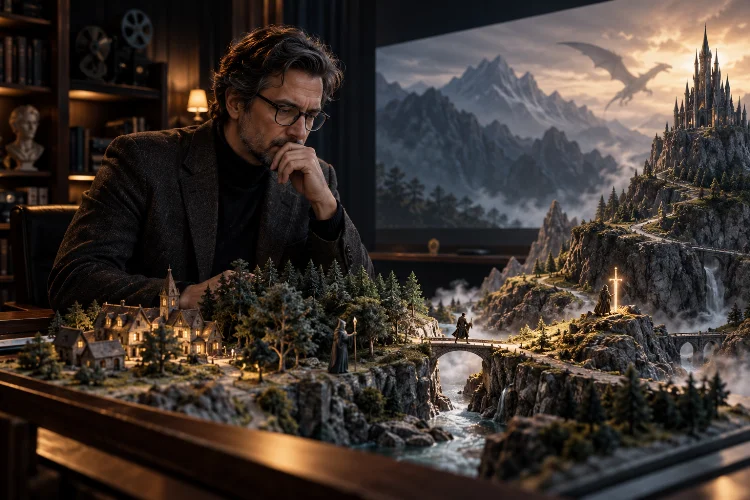
Fantasy movies often feel strangely familiar even when their worlds are completely new. A hero enters a forbidden forest, receives guidance from a mysterious mentor, confronts an ancient enemy, loses something important, and eventually returns transformed.
Dragons, magical cities, spirits, and enchanted weapons may change, but the deeper storytelling patterns often remain surprisingly consistent.
This is where advanced mythic structure analysis in modern fantasy movies becomes useful.
Instead of looking only at plot events, mythic analysis explores the symbolic architecture underneath them: journeys, thresholds, archetypes, sacrifice, death, rebirth, transformation, and the relationship between the individual and society.
Joseph Campbell’s Hero’s Journey remains one of the most famous frameworks for studying these patterns, but modern fantasy cinema rarely follows it mechanically.
Contemporary filmmakers combine classical mythology with psychology, folklore, cultural traditions, and deliberate narrative subversion.
Understanding those layers can reveal why films such as The Lord of the Rings, Pan’s Labyrinth, The Green Knight, and Suzume feel emotionally powerful even when their stories are radically different.
The Hero’s Journey Is a Framework, Not a Formula
Joseph Campbell popularized the idea of the “monomyth” in The Hero with a Thousand Faces, first published in 1949. His model broadly follows a movement of departure, initiation, and return, although the complete framework contains more detailed stages.
This structure appears clearly in fantasy cinema.
Frodo leaves the familiar safety of the Shire in The Lord of the Rings, enters increasingly dangerous territory, experiences physical and psychological trials, and eventually returns home as someone fundamentally changed.
However, advanced analysis should avoid treating the Hero’s Journey like a screenplay checklist. A movie does not need every traditional stage to contain a mythic structure. Modern filmmakers frequently compress, rearrange, reverse, or remove stages.
The more interesting question is not, “Where is the Call to Adventure?” but rather, “What kind of transformtion does the journey represent?”
That shift turns structural analysis into interpretation rather than simple pattern matching.
Archetypes Create Emotional Recognition
Mythic stories frequently use recognizable character roles: heroes, mentors, tricksters, guardians, shadows, companions, and shapeshifters.
These characters work because their function goes beyond moving the plot forward. They often represent psychological pressures or competing possibilities inside the protagonist.
Gandalf, for example, is not simply someone who gives Frodo information. He represents guidance, knowledge, moral responsibility, and the push toward a larger world.
A villain can operate in a similar symbolic way. The antagonist may externalize something the hero fears becoming.
This becomes especially interesting in The Green Knight. Gawain’s mysterious opponent is not merely a monster to defeat. The Green Knight represents mortality, consequence, nature, courage, and the unavoidable test of Gawain’s identity.
Advanced mythic analysis therefore asks what each archetypel figure means psychologically, rather than simply assigning labels to characters.
Thresholds Separate Ordinary Reality From Mythic Reality
One of the most important patterns in fantasy storytelling is the threshold.
Crossing a threshold means moving from a familiar reality into a space governed by different rules. The transition might involve entering a forest, crossing a bridge, opening a magical door, descending underground, traveling across an ocean, or stepping into another dimension.
These locations are rarely random.
When characters cross them, their social protection often disappears. They must face forces that cannot be controlled using their previous understanding of the world.
In Pan’s Labyrinth, for example, fantasy spaces operate alongside the brutal reality of Francoist Spain. The labyrinth and magical underworld create a second symbolic system through which fear, obedience, violence, innocence, and resistance can be examined.
The physical location becomes psychological territory.
That is why forests, caves, ruins, mountains, castles, and underground realms appear so frequently in myth-inspired fantasy. They function as what scholars often describe as liminal spaces: places between one state of existence and another.
Death and Rebirth Often Matter More Than Victory
Fantasy heroes frequently experience symbolic death before meaningful transformation becomes possible.
Sometimes the death is literal or nearly literal. In other stories, the character loses status, identity, certainty, relationships, power, or a previous understanding of reality.
The important element is destruction of the old self.
Consider Gandalf’s fall in The Lord of the Rings. His later return as Gandalf the White transforms both his appearance and narrative position. The pattern closely resembles mythological death-and-rebirth traditions in which transformation requires passing through darkness before gaining new authority.
But modern fantasy often makes this pattern subtler.
A character may survive physically while losing the identity that originally defined them. Their “rebirth” occurs when they accept a different understanding of themselves.
That means an advanced structural reading should track emotional death as carefully as physical danger.
Modern Fantasy Frequently Subverts the Heroic Pattern
Contemporary fantasy movies increasingly question traditional ideas about heroism.
Instead of presenting the chosen hero as naturally destined for greatness, films may portray destiny as a burden, political construction, misunderstanding, or dangerous fantasy.
The Green Knight is a strong example. The story contains many recognizable quest elements, but Gawain’s journey constantly undermines the expectation that heroism means winning battles. His greatest challenge becomes accepting responsibility and mortality.
Other films distribute heroic functions across several characters instead of building everything around one central savior.
This matters because traditional Hero’s Journey models can sometimes encourage analysts to flatten every story into the same structure. Even recent explanations of the monomyth caution that it works better as a framework for understanding character transformation than as a rigid list of required plot beats.
The most interesting modern fantasy stories often use familiar mythology precisely so they can challenge it.
Cultural Mythology Changes the Meaning of the Structure
Not every fantasy narrative should be interpreted primarily through Campbell.
Different cultures contain different religious traditions, folk beliefs, supernatural systems, ideas about death, relationships with nature, and concepts of community.
Makoto Shinkai’s Suzume, for example, can be interpreted through a Hero’s Journey framework, but its meaning becomes much richer when Japanese mythology, animism, Shinto imagery, memory, disaster, and place are included.
Academic analysis of Suzume has specifically connected its journey structure with Japanese mythology and folklore, showing how seemingly familiar heroic patterns can take on culturally specific meanings.
This is a crucial lesson for advanced analysis.
Finding a universal-looking pattern is only the beginning. The next question should be what that pattern means within the cultural world of the movie.
Ignoring cultural context can turn useful structural analysis into an overly simple narative template.
Propp Adds Another Layer to Fantasy Analysis
Joseph Campbell is not the only useful theorist for fantasy storytelling.
Russian folklorist Vladimir Propp studied recurring structures in folktales and identified 31 narrative functions.
Rather than focusing entirely on a hero’s psychological transformation, Propp examined recurring actions such as departure, prohibition, violation, testing, assistance, struggle, victory, and return.
This approach can be especially valuable when analysing fantasy movies based heavily on fairy-tale logic.
Imagine a magical object given to a protagonist. Campbell-style analysis might examine what the object symbolizes within the hero’s transformation. A Propp-inspired reading could instead ask what functional role the object plays in progressing the story.
Using both approaches creates a richer picture.
One explores symbolic transformation; the other reveals structural mechanics.
How to Perform an Advanced Mythic Structure Analysis
A useful analysis should begin by identifying the protagonist’s original psychological and social condition.
Then examine what disrupts that stability. Look for the first major threshold, the forces guiding or resisting the protagonist, and the sacrifices demanded as the journey progresses.
Next, pay attention to repeated imagery.
Water may represent rebirth. Forests can suggest uncertainty or the unconscious. Mountains may represent spiritual ascent. Ruins can connect the present to forgotten history. Masks, mirrors, doors, wounds, crowns, and magical objects may carry additional symoblic meaning.
Finally, compare the protagonist at the beginning and end.
If the external world changes but the character does not, the story may deliberately reject a traditional transformation arc. If the protagonist changes while society remains broken, the movie may be questioning whether personal heroism can actually solve systemic problems.
That is where mythic analysis becomes most valuable: not when it proves that familiar patterns exist, but when it explains why filmmakers use, modify, or reject them.
Advanced mythic structure analysis in modern fantasy movies goes far beyond spotting the Hero’s Journey. It involves examining archetypes, thresholds, symbolic death, transformation, cultural mythology, narrative functions, and the deliberate subversion of heroic traditions.
Campbell provides a powerful starting point, while thinkers such as Vladimir Propp offer additional ways to understand how fantasy narratives are constructed.
Modern films then reshape those older patterns according to contemporary questions about identity, power, trauma, community, responsibility, and cultural memory.
The next time you watch a fantasy movie, look underneath the dragons, magic, and spectacular battles. Ask what journey is actually taking place, what the fantasy world symbolizes, and what the hero must lose before transformation becomes possible.
That deeper layer is often where the real story lives.
