

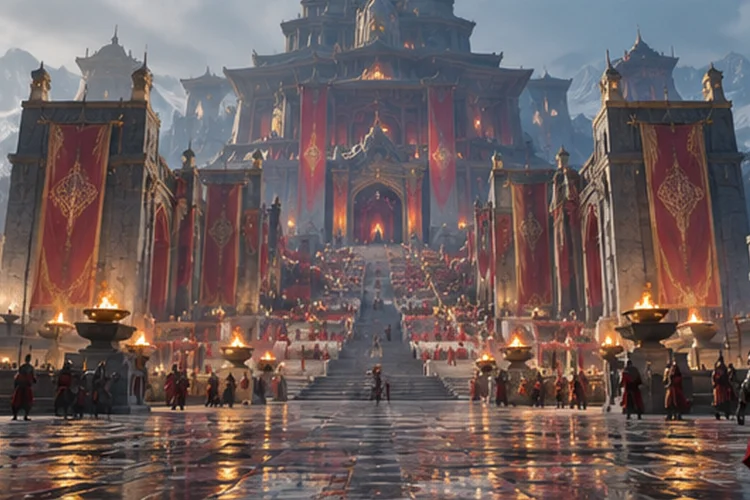
Great production design can tell you where a character comes from before they say a single word.
The shape of a doorway, patterns carved into furniture, colors used in public spaces, and materials chosen for clothing can all reveal something about culture.
When those details repeat consistently across a film, audiences begin recognizing an entire visual language. That is the idea behind advanced production design through cultural visual language.
Instead of designing beautiful sets individually, filmmakers create connected visual rules that reflect history, geography, belief, technology, social hierarchy, and collective identity.
Black Panther is one of the clearest modern examples. Wakanda feels distinctive because architecture, costumes, colors, technology, symbols, and landscapes seem to belong to the same civilization rather than different design departments.
Production designer Hannah Beachler researched architectural traditions and contemporary influences while imagining a technologically advanced society that had preserved strong cultural continuity.
The result shows what sophisticated production design can achieve: culture becomes visible before it needs to be explained.
Start With Cultural Values Before Designing Objects
A strong visual language begins with ideas, not decorations.
Before choosing furniture, buildings, or colors, designers can ask what the fictional society actually values. Does it admire ancestry, military strength, spiritual balance, technological progress, family loyalty, or individual achievement?
Those values should influence physical space.
A society built around collective ritual might create large gathering areas. A culture obsessed with ancestry could display genealogical symbols, portraits, monuments, or inherited objects throughout public architecture.
This prevents production design from becoming a collection of unrelated attractive images.
Every visual choice begins answering the same cultural questions.
That shared logic is what makes a fictional civilisation feel consistant.
Repeated Motifs Create Visual Recognition
Cultures often repeat recognizable forms.
Circles, triangles, animals, plants, geometric patterns, sacred symbols, and particular decorative rhythms can appear across architecture, clothing, tools, and ceremonial objects.
Wakanda demonstrates how useful this technique can be. Beachler discussed using circular design ideas while connecting them with concepts of vibration and the fictional properties of vibranium. The same world also combines traditional monuments with futuristic urban forms.
Repetition helps viewers learn visual meaning without exposition.
If the same symbol appears on a palace wall, ceremonial weapon, and royal garment, audiences naturally begin associating it with power or national identity.
The key is variation.
Repeating a motif does not mean copying the exact same decoration everywhere. Instead, the underlying idea can be adapted to different scales and materials.
That creates cultural cohesion without making every object look identical.
Color Can Organize Social and Cultural Identity
Color is one of the fastest ways to communicate cultural information.
A production designer can use palettes to separate regions, institutions, social classes, religious groups, or political factions.
Black Panther coordinated costume and production design especially carefully. Ruth E.
Carter described specific color directions for different Wakandan groups, including green for the River Tribe, blue for the Border Tribe, black and royal purple around the Panther and royal palace, and wooden material associations for the Jabari.
These distinctions make a complicated fictional society easier to read.
But advanced color design goes beyond giving every faction its own shade.
The palettes should still belong to the same broader visual world.
Shared saturation levels, materials, patterns, or accents can connect different communities while preserving regional identity.
Color becomes cultural grammar rather than simple decoration.
Materials Should Reflect Culture, Geography, and Technology
Material choice gives visual language physical weight.
Stone suggests different possibilities from polished metal. Wood communicates something different from glass, clay, leather, or woven fibers.
These materials should ideally connect to the fictional enviroment.
A mountain culture may depend heavily on stone and metal. A forest society might develop sophisticated woodworking traditions. An advanced civilization could combine natural materials with technologies that transform how those materials are processed.
Wakanda is effective because vibranium is not limited to superhero equipment. The fictional resource helps explain the country’s technological development, architecture, transportation, and prosperity.
Material culture therefore becomes part of worldbuilding.
The audience begins to understand not only what objects look like, but why that society can produce them.
That makes visual design feel economically and culturally grounded.
Architecture Should Express Social Structure
Buildings tell audiences who has power.
A ruler positioned high above visitors communicates hierarchy through space. A society with open civic plazas may suggest different public values from one dominated by restricted compounds and defensive walls.
The placement of buildings matters too.
Is the temple beside the palace? Is the marketplace at the center of town? Do wealthy districts physically overlook poorer neighborhoods?
These choices transform architechture into political storytelling.
Production design teams are responsible for creating the environments that pull audiences into character worlds, a role BAFTA highlighted while marking 50 years of its Production Design award category in 2026.
Fantasy films especially benefit from this approach because fictional political systems cannot rely on audiences already knowing their institutions.
The built environment can explain them visually.
Cultural Research Creates Specificity
Generic fantasy often relies on familiar combinations of stone castles, leather armor, candles, wooden taverns, and vaguely medieval furniture.
Research helps filmmakers escape that visual shorthand.
For Black Panther, Beachler explored architecture across places including Senegal, Nigeria, Kenya, Uganda, and Johannesburg, while also looking at architects such as Zaha Hadid.
The goal was not to reproduce one real culture but to build a fictional society from multiple carefully considered influences.
That distinction matters.
Cultural research should provide structure, history, craftsmanship, and ideas – not simply visual elements to copy.
Understanding why a form exists is more useful than borrowing the form alone.
A pattern may have ceremonial meaning. A building technique might respond to climate. A particular material could indicate regional trade or social status.
Knowing those relationships allows designers to transform inspiration into original worldbuilding.
Costume and Set Design Need a Shared Visual Language
A fictional culture feels much stronger when people look like they belong inside the spaces surrounding them.
Costumes, furniture, architecture, weapons, and props should therefore communicate with one another.
That does not mean matching everything perfectly.
Instead, departments can share motifs, materials, color logic, craftsmanship, or historical influences.
The collaboration between Hannah Beachler’s production design and Ruth E. Carter’s costume work on Black Panther is a strong example. Carter explicitly coordinated palettes and cultural references with the larger design of Wakanda.
The film ultimately won the Academy Awards for both Production Design and Costume Design in 2019, with Beachler becoming the first Black winner in the Production Design category.
That kind of coordination makes culture feel systemic.
The character does not appear to be wearing a costume inside a set.
They appear to belong to a place.
Different Groups Need Variation Within the Same Culture
Believable cultures are rarely visually uniform.
Regions, classes, professions, religions, and generations develop their own variations.
A royal family may use luxurious versions of patterns that also appear in ordinary homes. Rural communities might preserve older architectural forms while urban centers adopt newer materials.
This variation is essential because total uniformity makes a fictional society feel artificial.
At the same time, too much variation can make the world visually confusing.
Advanced design therefore balances difference with continuity.
Wakanda again provides a useful model. Its different communities have distinctive palettes, materials, and identities while remaining recognizably part of one larger cultural system.
The same principle can apply to almost any fantasy civilisation.
Regional differences make the world wider.
Shared visual rules keep it connected.
History Should Be Visible in the Design
A society should not look as though everything was built yesterday.
Older monuments, repaired walls, inherited furniture, changed street layouts, and modern additions to traditional buildings can create layers of time.
Marvel’s discussion of Wakanda describes the concept of centuries-old monuments standing beside extremely modern skyscrapers because technological progress did not erase cultural traditions.
That idea is extremely useful for production design.
History becomes something viewers can see.
The Lord of the Rings design tradition uses a similar worldbuilding philosophy.
Wētā Workshop describes developing environments, armor, creatures, and weapons for The War of the Rohirrim by drawing deeply from Tolkien’s legendarium while maintaining the broader visual ethos established for Middle-earth.
Historical continuity creates identity.
A culture becomes more convincing when newer designs appear to have evolved from older ones.
Visual Language Should Support the Story
Production design can become so elaborate that filmmakers forget its most important purpose: storytelling.
Every design choice should ultimately help audiences understand character, culture, conflict, or emotion.
A ceremonial chamber might appear impressive, but its layout should reveal something about authority. A sacred symbol matters more when characters respond to it differently.
The strongest visual language also changes with the story.
A symbol associated with national unity might later become politically contested. A palace that initially feels magnificent could eventually appear oppressive once the audience understands who benefits from its power.
This gives visual motifs narrative development.
They are not static decorations.
Their meaning evolves as the audience learns more about the fictional culture.
That is where production design becomes genuinely symoblic rather than simply attractive.
Advanced production design through cultural visual language is about creating connections between visual choices.
Architecture reflects political structures. Materials reveal resources and technology. Colors organize identity, while motifs, costumes, props, and spatial layouts communicate cultural values.
The strongest fictional worlds also contain variation and history. Different communities develop distinct identities, while older visual traditions remain visible underneath newer ones.
Films such as Black Panther demonstrate how powerful this approach can become when production design and costume work share the same cultural logic.
Next time you watch an ambitious fantasy or science-fiction film, look for repeated shapes, materials, colors, and symbols.
Ask why they keep appearing and which characters are associated with them.
Once those patterns become visible, you are no longer simply looking at a set. You are reading the visual language of an entire culture.
