

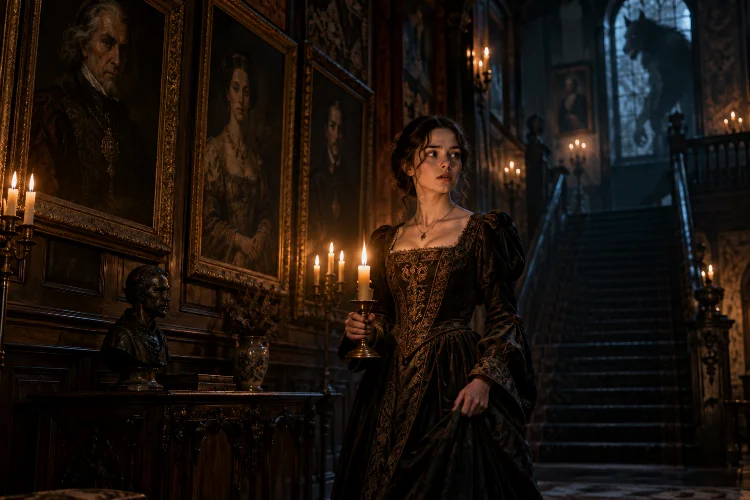
In Gothic fantasy, being born into the wrong family can be more dangerous than entering a haunted castle.
A character may inherit an impressive estate, an ancient title, or a respected family name, only to discover that something darker was passed down with it. Perhaps an ancestor committed a terrible crime.
Maybe supernatural transformation runs through the family. Sometimes the inheritance is psychological rather than magical: generations repeat the same violence because nobody has confronted what happened before.
Understanding how cursed bloodlines drive Gothic fantasy movie narratives reveals why family history is such a powerful storytelling device. A bloodline connects past and present automatically, allowing filmmakers to turn old sins into immediate danger.
Movies involving werewolves, vampires, aristocratic families, haunted houses, and hereditary supernatural forces repeatedly return to this structure.
The central question is rarely just whether a character can defeat a monster.
It is whether they can escape something that was already part of them before they understood what it meant.
A Cursed Bloodline Makes History Personal
Gothic stories are obsessed with the past, but cursed bloodlines make that past impossible to treat as distant history.
An ancestor’s mistake becomes a descendant’s problem.
Perhaps someone made a supernatural bargain generations earlier. Maybe a family accumulated wealth through murder, betrayal, or exploitation. Their descendants may know almost nothing about the original event, yet they still live with its consequences.
This gives exposition emotional weight.
Instead of hearing a long story about an ancient tragedy involving strangers, the protagonist discovers that the tragedy belongs to their own family.
Suddenly history becomes identity.
This pattern is closely related to the Gothic tradition’s fascination with dark family secrets, ruined aristocratic households, and old crimes that refuse to disappear.
BFI’s discussion of Southern Gothic cinema, for example, highlights family secrets, lost loves, inherited historical violence, and decaying estates as recurring elements of the form.
The family tree effectively becomes part of the plot.
Every generation adds another layer.
Inheritance Turns Identity Into a Source of Fear
Most coming-of-age stories ask, “Who am I becoming?”
Gothic bloodline narratives add a more disturbing question: “What if I am becoming my family?”
That fear works particularly well when transformation is physical.
Werewolf stories provide an obvious example. In The Wolf Man, Larry Talbot returns to his ancestral home and becomes cursed after being bitten while trying to save another person. His transformation connects desire, family history, and an unavoidable loss of control.
More recent reinterpretations continue using lycanthropy as hereditary anxiety. Leigh Whannell’s Wolf Man frames monstrous transformation through fatherhood and a troubling inheritance passed through generations.
The supernatural condition therefore becomes more than a creature effect.
It represents the fear that personality, violence, addiction, anger, or emotional damage may be inherited.
Characters do not merely fear the monster outside.
They fear discovering that the monster already belongs to them.
Family Secrets Create Natural Mystery Structure
A cursed bloodline is also an excellent mystery engine.
The protagonist rarely receives the complete truth immediately.
Instead, information arrives in fragments: an old portrait, a missing relative, a locked bedroom, a strange family tradition, or a local person who becomes uncomfortable when a particular surname is mentioned.
Each discovery changes how the protagonist understands their family.
This gives Gothic fantasy a natural investigative structure.
The deeper the character searches, the more personally dangerous the information becomes.
Crimson Peak uses a similar pattern through the Sharpe family.
Edith enters their decaying ancestral home knowing very little about its history, then gradually discovers earlier marriages, murders, financial desperation, and the disturbing relationship between Thomas and Lucille.
BFI notes how the film draws heavily on Gothic traditions involving mysterious marriages, isolated houses, hidden evidence, and sinister family relationships.
The secret is frightening because it is not random.
It explains why the family behaves the way it does.
The Curse Often Represents Inherited Guilt
Not every cursed lineage needs literal magic.
Sometimes the real curse is guilt.
A family may survive because an ancestor committed a crime. Wealth may have been built on exploitation. Political power might depend on a betrayal that later generations refuse to acknowledge.
This creates moral inheritance.
The descendant did not commit the original act, yet they benefit from it or remain trapped inside the structure it created.
That produces a difficult question: how responsible are people for histories they did not choose?
Gothic fantasy works especially well with this idea because supernatural curses can transform abstract guilt into visible consequences.
The house decays.
The ghosts appear.
Children repeat their parents’ mistakes.
A supposedly respectable family gradually reveals that its prosperity has always depended on something ugly.
The curse becomes a metaphor for historical consequences.
Ignoring the past does not make it disappear.
It simply gives the past more time to grow.
Ancestral Houses Make Bloodlines Visible
Cursed families often come with cursed houses.
That is not a coincidence.
An ancestral mansion physically connects different generations. The same bedroom may have belonged to grandparents, parents, and children. Portraits preserve faces. Furniture survives its owners.
Architecture becomes a family archive.
This is especially effective in Crimson Peak, where Allerdale Hall visibly reflects the collapse of the Sharpe family. The building is enormous but deteriorating, with snow entering through its damaged roof and red clay staining its surroundings.
The family’s decline becomes architectural.
Their secrets exist in rooms, basements, photographs, recordings, and objects that previous generations left behind.
This creates one of Gothic fantasy’s strongest visual relationships: blood and building.
The family owns the house, but the house also seems to own them.
Leaving it would mean abandoning their identity.
Remaining means living inside everything the family refuses to confront.
Curses Create Conflict Between Fate and Choice
A hereditary curse seems unfair because the character did nothing to earn it.
That unfairness creates drama.
If transformation, madness, death, or supernatural persecution is predetermined by ancestry, the protagonist must decide whether destiny can actually be resisted.
This is where bloodline stories become more than family mysteries.
They become stories about agency.
A character might spend the entire film trying not to become their father. Another may believe the curse is unavoidable and therefore behave destructively because resistance seems pointless.
The most interesting narratives leave some uncertainty.
Perhaps the curse is real, but personality determines how someone responds to it.
Maybe supernatural inheritance creates violent impulses without forcing violent behavior.
Now the character has a meaningful choice.
The curse defines the problem.
It does not necessarily define the ending.
That distinction prevents hereditary horror from becoming narrativly predictable.
Bloodlines Can Preserve Power as Well as Horror
A family curse does not always involve suffering alone.
Sometimes the bloodline provides extraordinary power.
Vampire families may receive immortality. Magical dynasties might control abilities unavailable to ordinary people. Royal families can claim political authority through supposedly sacred ancestry.
The curse and privilege can exist together.
That makes the system more interesting.
A character may hate what their lineage demands while benefiting from the abilities or status it provides. Escaping the family might mean losing wealth, supernatural power, protection, or social identity.
Gothic fantasy frequently connects aristocracy with this kind of dangerous inheritance.
Ancient families live inside beautiful estates while hiding corruption beneath the surface.
Even modern Gothic traditions preserve the appeal of powerful supernatural families.
BFI’s discussion of the Gothic tradition traces this fascination from older vampire aristocrats into contemporary screen stories where beauty, danger, family property, and supernatural identity remain intertwined.
The curse becomes tempting.
And temptation makes escape much harder.
Repetition Across Generations Creates Gothic Dread
One of the most disturbing ideas in cursed-family stories is repetition.
A son becomes like his father.
A daughter repeats her mother’s relationship.
The same room witnesses another death.
A family that once promised never to repeat an old mistake gradually recreates it almost exactly.
This pattern creates dread because audiences may recognize what is happening before the characters do.
The first generation establishes the pattern.
The next generation appears to escape it.
Then familiar details begin returning.
Gothic storytelling is particularly effective when these repetitions are slightly different rather than identical. Small variations keep the story from feeling mechanical while suggesting that the underlying problem remains unresolved.
The curse therefore behaves almost like a narrtive rhythm.
History repeats until someone understands why it keeps repeating.
Breaking the cycle usually requires more than defeating a supernatural creature.
The character must reject a belief, behavior, silence, or form of power that earlier generations accepted.
Breaking the Curse Requires Confronting the Past
Cursed bloodlines create satisfying endings when breaking the curse requires emotional change.
Simply finding a magical object and destroying it can work, but it may feel shallow if the entire movie has explored generations of family trauma.
A stronger resolution connects the supernatural solution with the thematic one.
The protagonist might expose a hidden crime instead of protecting the family reputation. They may abandon an inherited title, destroy the ancestral estate, forgive someone, or refuse to reproduce the behavior that created the curse.
In Gothic fantasy, confronting truth is often more important than defeating evil physically.
This is why family secrets are so often hidden inside basements, forbidden rooms, diaries, or sealed archives.
The protagonist must literally enter the family’s buried history.
Once the truth is known, they can decide what to inherit and what to leave behind.
That decision transforms ancestry from destiny into choice.
Cursed Bloodlines Make Personal Stakes Feel Epic
Fantasy films often involve enormous external stakes.
Kingdoms collapse. Monsters awaken. Ancient forces threaten civilization.
Bloodline stories create equally powerful stakes on a smaller scale.
One family becomes a miniature version of an entire society.
Its hierarchy represents political authority. Its secrets represent historical repression. Its inherited wealth reflects inequality. Its curse becomes the consequence of refusing to change.
That is why cursed-family stories can feel epic without requiring giant armies.
The conflict may take place inside one old mansion, yet the themes involve generations.
Crimson Peak demonstrates this beautifully: its central mystery revolves around a relatively small number of people, but their relationships contain class decline, inherited property, economic desperation, murder, desire, and family obsession.
The family becomes its own world.
And the curse becomes its history.
Cursed bloodlines drive Gothic fantasy movie narratives because they connect supernatural danger with something characters cannot easily escape: family.
A hereditary curse can turn history into personal identity, transform ancestral houses into archives, and make inherited guilt physically visible.
Werewolves, aristocratic secrets, supernatural dynasties, and repeating family tragedies all use the same deeper mechanism – the fear that the past may already be living inside the present.
The strongest stories still leave room for choice. Characters may inherit a curse, but they can sometimes decide whether to repeat the behavior that sustains it.
Next time a Gothic fantasy film introduces an ancient family name, portrait gallery, or mysterious ancestor, pay attention.
The monster may not have entered the family.
It may have been passed down all along.
