

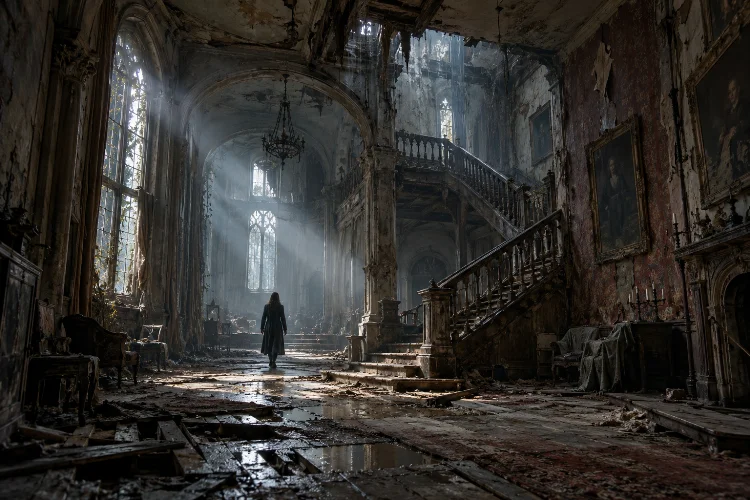
A perfectly maintained castle can look impressive, but a castle with cracked walls, rotting floors, leaking ceilings, and sealed rooms immediately raises questions. Who lived here? What happened to them? Why has nobody repaired the damage?
That curiosity is exactly why ruined buildings work so well in Gothic fantasy. Understanding how decaying architecture shapes Gothic fantasy film atmosphere means looking beyond old mansions as decorative scenery.
In strong Gothic filmmaking, architecture controls movement, reveals history, creates psychological pressure, and visually represents families or institutions that are collapsing from within.
Films such as Crimson Peak, The Others, Rebecca, and the modern Nosferatu tradition demonstrate how houses and castles can become almost as important as the characters inhabiting them.
Rotting architecture also gives fantasy worlds something digital spectacle sometimes struggles to provide: evidence of time.
A cracked staircase, faded wallpaper, or abandoned corridor suggests that the story began long before the protagonist arrived – and that the building remembers things its inhabitants would rather forget.
Decay Makes Buildings Feel Like They Have a Past
New buildings tell audiences what exists now.
Ruins tell them what used to exist.
That difference is essential to Gothic atmosphere.
A collapsed wing of a mansion suggests former wealth. Dust-covered furniture implies abandonment. Old portraits indicate previous generations whose influence may still shape the current household.
The setting therefore becomes historical evidence.
Crimson Peak uses this technique almost aggressively. BFI describes the ruined Allerdale Hall as the visual centerpiece of the film, with snow and leaves entering through a hole in the roof while red clay appears to bleed through the surrounding landscape.
The house does not merely look old.
Its deterioration communicates the decline of the Sharpe family.
That relationship between physical damage and social collapse makes Gothic architechture particularly effective. Instead of explaining that a family has lost its former status, the movie allows viewers to see the evidence in every corridor.
The Gothic House Can Function Like a Character
A memorable Gothic building rarely feels passive.
Doors resist being opened. Floorboards make sounds. Corridors redirect characters. Elevators descend into places they should probably avoid.
The architecture begins behaving almost like another character.
Classic Gothic cinema established this pattern long before contemporary dark fantasy.
Criterion’s discussion of Alfred Hitchcock’s Rebecca highlights how the fictional Manderley estate was constructed through elaborate sets, miniatures, matte paintings, and careful production design to create scale, texture, and unease.
The building becomes emotionally present.
It can dominate characters physically through enormous rooms or psychologically through objects associated with previous occupants.
This works because people naturally interpret spaces.
A warm kitchen feels different from a locked basement. A narrow corridor creates different expectations from an open ballroom.
Filmmakers can therefore manipulate architectural space the same way they manipulate dialogue or music.
Deterioration Turns Space Into Psychological Metaphor
Gothic fantasy frequently connects damaged buildings with damaged minds.
A house filled with sealed rooms may reflect repression. A collapsing roof can represent a family losing control. A basement may hold memories that characters refuse to acknowledge.
This symbolism does not need to be subtle to work.
In The Others, the remote manor is defined by darkness, closed curtains, locked doors, and strict rules about movement. Criterion describes the film as a Gothic ghost story haunted not only by supernatural forces but also by guilt, trauma, and repression.
The spatial design supports those themes.
Characters are physically restricted because they are psychologically restricted.
That connection is especially valuable in fantasy cinema because supernatural events can externalize internal fears. A haunting might represent unresolved grief, while a deteriorating building makes emotional deterioration visible.
The architecture becomes a map of the protagonist’s psycological state.
Cracks and Damage Create Visual Uncertainty
Perfect architecture creates predictability.
Decay disrupts it.
A staircase may collapse. A door may no longer close properly. A corridor could be partially blocked. Floors may lead into spaces that were never intended to be exposed.
That instability changes the atmoshpere because audiences stop trusting the environment.
This creates suspense without requiring a monster to appear.
Even an empty room can feel threatening if the ceiling looks unstable or the walls suggest hidden spaces behind them.
Gothic filmmaking often depends on this uncertainty. The viewer begins scanning the frame for evidence: a crack, shadow, doorway, damaged mirror, or movement behind torn curtains.
The building becomes visually unreadable.
That unreadability matters because horror and dark fantasy thrive on incomplete information.
When audiences cannot immediately understand the space, they cannot confidently predict what may enter it.
Nature Invading Architecture Signals Lost Control
One of the most effective images in Gothic fantasy is nature entering a human structure.
Roots break through floors. Moss covers stone. Snow falls inside. Water leaks through ceilings. Vines climb across windows.
The message is simple: human control is disappearing.
Allerdale Hall in Crimson Peak turns this principle into a central visual idea. Its damaged roof allows the outside world to penetrate the interior, while the surrounding red clay physically contaminates the house and landscape.
BFI specifically praises the film’s crumbling production design as central to its Gothic effect.
Nature becomes a clock.
The longer maintenance stops, the more aggressively the environment reclaims the structure.
This creates a useful contrast in fantasy storytelling.
Castles and mansions usually symbolize stability, wealth, and human authority. When weather and vegetation begin dismantling them, that authority suddenly looks temporary.
The building may have survived generations.
It will not survive forever.
Vertical Space Creates Hierarchy and Fear
Gothic architecture frequently uses verticality.
Towers rise above characters. Basements descend beneath them. Staircases connect private rooms with forbidden spaces.
These vertical relationships can communicate power.
Upper floors may contain bedrooms, family portraits, or spaces associated with authority. Basements frequently hold secrets, bodies, machinery, or evidence that society wants hidden.
Crimson Peak makes particularly effective use of downward movement. Its cage-like lift carries characters into a red-clay basement where the visual palette and physical texture become increasingly disturbing.
Descending therefore becomes narrative movement.
The protagonist is not simply moving downstairs.
She is moving deeper into the truth.
This principle can be applied to fantasy castles, monasteries, ruined towers, and underground kingdoms. Architecture gives abstract concepts such as secrecy and hierarchy a physical direction.
Power is above.
Buried memory is below.
Material Texture Makes Decay Feel Physical
Gothic atmosphere depends heavily on surfaces.
Polished CGI walls may communicate scale, but texture communicates age.
Peeling paint, damp stone, rusted metal, warped wood, cracked plaster, and stained fabric give viewers clues about temperature, smell, moisture, and neglect even though cinema cannot literally provide those sensations.
Production designers use these details to make fantasy environments feel physically inhabited.
The importance of controlled physical design remains visible in recent Gothic cinema.
Robert Eggers’ Nosferatu used constructed sets for major environments including Orlok’s castle, while cinematographer Jarin Blaschke described carefully designing light to make those spaces feel naturally illuminated across different times of day.
Lighting and materials work together.
Rough walls catch shadows differently from smooth ones. Dust softens light. Dark wood absorbs it.
Decay therefore influences cinematography as much as production design.
A deteriorating room does not merely contain darkness.
It shapes darkness.
Empty Space Can Feel More Threatening Than Clutter
Gothic buildings are often enormous compared with the number of people living inside them.
That imbalance creates loneliness.
One character walking through a huge dining hall immediately appears vulnerable. Empty bedrooms suggest missing inhabitants. Unused wings of a house make audiences wonder why those spaces have been abandoned.
The classic haunted-house tradition repeatedly uses this effect.
Criterion describes The Uninvited as centering on an isolated cliff-top house containing locked rooms, family tragedy, cold disturbances, and supernatural secrets.
Empty space becomes narrative potential.
Anything could be inside those unused rooms.
More importantly, emptiness hints at absence.
Someone used to live there.
Someone may have disappeared.
In Gothic fantasy, what is missing can be just as important as what remains.
Architecture Can Preserve Trauma
A ruined building is essentially a physical memory.
It stores evidence.
A damaged nursery might preserve traces of a dead child. A sealed chamber could contain evidence of family violence. A burned chapel may record religious conflict long after the people involved have disappeared.
Recent Gothic scholarship has explicitly examined underground architectural spaces as locations where repressed histories remain present.
A 2026 Cambridge-listed chapter on Gothic cinema describes the cellar-like tehkhana as a space holding unresolved testimonies and legacies of political and historical power.
This idea is useful far beyond horror.
Fantasy filmmakers can treat ruined architecture as an archive.
Characters explore history by physically moving through its remains.
Instead of receiving a long flashback explaining an ancient tragedy, they might discover scratches on a wall, abandoned objects, blocked passages, or rooms that were deliberately hidden.
That makes exposition active.
The protagonist does not simply hear about the past.
They enter it.
Cinematography Completes the Illusion
Architecture alone cannot create Gothic mood.
The camera must decide how audiences experience it.
Wide shots can make characters appear small inside enormous halls. Symmetrical framing creates unnatural order. Low angles exaggerate towers and ceilings, while narrow compositions make corridors feel claustrophobic.
Light is equally important.
The cinematography of Nosferatu demonstrates how carefully Gothic environments can be shaped through controlled darkness. Blaschke has explained that the film’s moonlit scenes minimized color information and depended on subtle gradations of light and shadow.
The result is not simply a dark building.
It is a building whose boundaries become difficult to read.
That uncertainty allows architecture to hide information.
A doorway disappears into blackness. The end of a corridor becomes ambiguous. Objects merge with shadows.
The audience knows the room continues.
They simply cannot see what occupies the rest of it.
That is classic Gothic tension.
Decaying architecture shapes Gothic fantasy film atmosphere because ruined buildings can perform several storytelling jobs at once.
They establish history, communicate social decline, reflect psychological instability, hide secrets, and control how characters move through the story.
Films such as Crimson Peak, The Others, Rebecca, and Nosferatu show that Gothic spaces become most powerful when architecture feels connected to memory and emotion.
Cracked walls and abandoned rooms matter because they suggest that something happened there – and that its consequences have not disappeared.
Next time you watch a Gothic fantasy movie, pay attention to the building before looking for the ghost. Notice the damaged surfaces, unused rooms, blocked corridors, leaking ceilings, and spaces characters avoid.
Often, the architecture has already told you what kind of horror is coming.
