

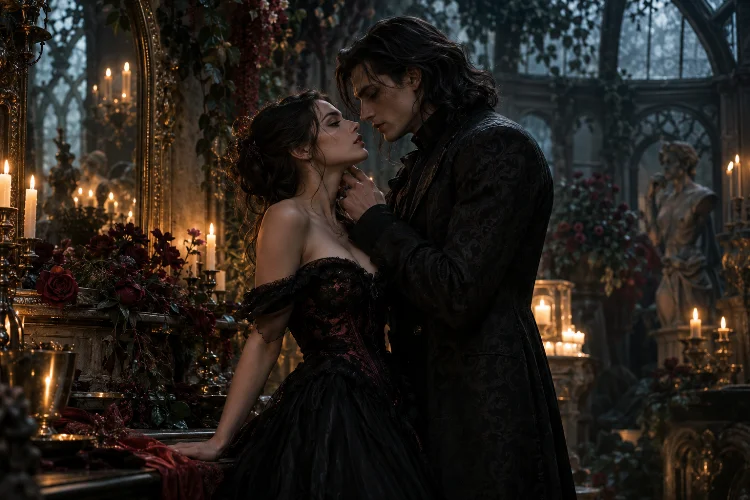
Gothic romance has never been particularly interested in healthy dating.
Its lovers meet in haunted mansions, fall for mysterious strangers, become obsessed with dead partners, discover terrible family secrets, or realize that the beautiful person across the room may not be entirely human.
Love is rarely safe because danger is part of the attraction. That contradiction sits at the center of advanced romantic horror elements in Gothic fantasy cinema.
These films combine desire with fear, creating relationships in which intimacy can offer emotional salvation while simultaneously threatening identity, freedom, or even life.
Movies such as Rebecca, Crimson Peak, The Shape of Water, and various interpretations of vampire mythology demonstrate how flexible this combination can be. Romance creates vulnerability, while supernatural horror turns that vulnerability into suspense.
The result is different from simply adding a love subplot to a horror movie.
In Gothic fantasy, romance and horror frequently create each other. The closer characters become, the more dangerous the story gets.
Attraction Works Best When It Also Feels Dangerous
Romantic horror begins with contradiction.
The audience must understand why one character is attracted to another while simultaneously recognizing that something about the relationship feels wrong.
That tension creates anticipation.
The mysterious aristocrat may be elegant but emotionally unreadable. A supernatural creature could appear frightening yet show unexpected tenderness. A charming stranger might offer escape from ordinary life while hiding motives that become increasingly disturbing.
Crimson Peak is built around this dynamic.
Edith Cushing is drawn toward the mysterious Thomas Sharpe and eventually follows him to Allerdale Hall, where romance becomes inseparable from family secrets, murder, ghosts, and obsession.
Guillermo del Toro himself has described the movie as a Gothic romance rather than straightforward horror.
The attraction matters because Edith cannot simply recognize danger and walk away.
Emotion keeps her inside the story.
Romantic horror works when desire reduces the distance between the protagonist and whatever they should probably fear.
Intimacy Makes Horror More Personal
A monster attacking strangers can be frightening.
A monster knowing exactly what a character wants is more disturbing.
Romantic horror uses intamacy to make supernatural danger personal. Lovers know weaknesses, insecurities, memories, and private desires that an ordinary antagonist would never possess.
This changes the emotional stakes.
A haunted lover can hurt someone psychologically before doing anything physically. Betrayal becomes more painful because trust existed first.
Gothic cinema has repeatedly connected romance with psychological vulnerability. The BFI describes Alfred Hitchcock’s Rebecca as a Gothic romance centered on guilt, anxiety, love, obsession, and power.
The unnamed heroine initially believes marriage to Maxim de Winter represents romantic fulfillment.
Instead, entering Manderley means entering a relationship already haunted by another woman.
The horror therefore grows directly from intimacy.
Love does not protect the heroine from the haunted space.
Love is what brings her into it.
Dead Lovers Can Remain Powerful Characters
Gothic romance has an unusual relationship with death.
A person does not necessarily stop influencing the story after dying.
Their portrait remains on the wall. Their clothing stays in a bedroom. Another character constantly talks about them. Their memory becomes so powerful that the living feel they are competing with a ghost.
Rebecca provides one of cinema’s most famous versions of this idea.
Rebecca herself never appears alive in the film, yet her presence controls Manderley and shapes the emotional relationship between Maxim and his second wife.
Criterion describes the film as transforming romance into psychodrama, with the dead Rebecca continuing to haunt both the estate and Maxim.
This is a perfect Gothic technique because memory becomes supernatural even when an actual ghost is unnecessary.
The dead lover represents an impossible competitor.
They cannot make new mistakes, change, grow older, or disappoint anyone.
Memory can preserve them forever.
Romantic horror turns that idealization into something dangerouse.
Obsession Distorts the Meaning of Love
Gothic cinema repeatedly asks when devotion becomes possession.
The difference can be surprisingly thin.
A character may believe intense jealousy proves emotional commitment. Someone else may preserve the room of a dead lover for decades.
Another person might decide that loving someone means controlling where they go, whom they speak to, or whether they are allowed to leave.
These stories deliberately blur romantic language with disturbing behavior.
The Female Gothic tradition is particularly useful for understanding this pattern. Cambridge scholarship describes Female Gothic cinema as frequently exploring women’s fears, desires, trauma, confinement, and unstable identity inside threatening patriarchal environments.
Romance can therefore become a trap disguised as security.
A mansion, marriage, or wealthy partner initially appears to offer stability.
Gradually, the same things begin restricting the protagonist.
This transformation makes obsession one of Gothic romance’s most effective horror devices.
The terrifying lover is often someone who believes possession and affection are the same thing.
Monsters Complicate What Audiences Consider Lovable
Romantic fantasy becomes particularly interesting when one partner is visibly nonhuman.
Traditional monster stories encourage audiences to fear physical difference.
Romantic Gothic stories can reverse that expectation.
Guillermo del Toro has explored this repeatedly, but The Shape of Water offers one of the clearest examples. The film centers on a relationship between Elisa, an isolated cleaner, and an amphibious creature held inside a government facility.
Del Toro has described the movie as a love story between outsiders, with the seemingly monstrous character becoming a source of connection rather than simple terror.
This reverses the usual Gothic question.
Instead of asking whether the monster is secretly human, the film asks whether supposedly normal humans are necessarily more compassionate.
Romantic horror becomes a tool for challenging appearance.
A beautiful human character may be manipulative and violent. A frightening creature may be gentle.
Once that distinction collapses, monstrosity becomes ethical rather than physical.
Desire and Death Naturally Intensify Each Other
Gothic romance often places love beside death because both involve vulnerability.
To love someone means accepting the possibility of losing them.
Supernatural cinema can make that anxiety literal.
Vampires are especially useful because they combine erotic attraction with mortality. A vampire bite can represent intimacy, violence, transformation, and death at the same time.
Immortality complicates romance even further.
If one lover lives forever while another ages normally, love suddenly contains an unavoidable imbalance. Turning the mortal partner into an immortal may solve one problem while creating another: what exactly must they give up to remain together?
These contradictions explain why vampires remain remarkably durable romantic figures.
The Gothic is comfortable with emotions that refuse simple categories.
Love can be beautiful and destructive.
Desire can offer liberation while removing control.
Death can separate lovers – or become the thing that binds them permanently.
Forbidden Relationships Create Gothic Tension
Many Gothic romances involve relationships that society considers impossible.
The barrier may involve class, family, religion, species, supernatural identity, or cultural expectations.
Prohibition makes desire stronger because characters must choose between emotional fulfillment and established rules.
This structure also creates a useful connection between personal romance and wider fantasy worldbuilding.
Imagine a human falling in love with a member of a supernatural species considered dangerous. Their relationship immediately raises questions about prejudice, law, religion, and political power.
The romance becomes a test of the fictional society.
Gothic cinema has long combined these elements across horror, fantasy, melodrama, and romance rather than operating as one completely separate genre.
Cambridge’s overview of Gothic film emphasizes precisely this flexibility, noting that Gothic characters, imagery, and plots move freely through different cinematic categories.
Forbidden love is especially effective because it makes social boundaries emotional.
The audience no longer debates an abstract rule.
They see exactly whom that rule prevents from being together.
Romantic Spaces Can Become Traps
Gothic romance depends heavily on setting.
A castle, manor, hotel, isolated estate, or forest retreat may initially seem perfect for intimacy because it separates lovers from ordinary society.
Then isolation becomes threatening.
There are fewer witnesses. Roads are difficult to travel. Phones stop working. Doors become locked.
The romantic retreat becomes a prison.
Crimson Peak uses Allerdale Hall in exactly this way. Thomas brings Edith into an apparently romantic new life, but the crumbling mansion gradually reveals itself as a physical record of secrecy, dependency, jealousy, and murder.
BFI highlights the house’s decaying environment as one of the film’s defining Gothic achievements.
Architecture therefore tracks the relationship.
What first appears mysterious becomes claustrophobic.
Beauty becomes decay.
Privacy becomes isolation.
The enviroment warns Edith about the romance before she completely understands the danger herself.
Dreams and Fantasy Make Desire Less Reliable
Romantic attraction already affects judgment.
Gothic fantasy makes that instability stronger by introducing dreams, visions, ghosts, enchantment, and altered states.
A protagonist may not know whether someone genuinely loves them or has magically manipulated their feelings.
They may dream about a mysterious stranger before meeting them. A ghost can appear as a lost partner. Supernatural forces may exploit loneliness by offering an idealized relationship.
This dreamlike quality has deep connections with Gothic cinema. Recent Cambridge scholarship on oneiric horror examines how dream states and supernatural imagery blur the boundary between psychological and external reality.
Romance benefits from that uncertainty because attraction itself can feel irrational.
Fantasy simply makes the feeling visible.
The hero knows something may be wrong.
Yet they still want the relationship to be real.
That emotional contradiction produces a particularly effective form of suspense.
Tragic Love Often Matters More Than Happy Endings
Gothic romance does not require a conventional romantic ending.
In fact, melancholly often gives these stories their lasting power.
Lovers may discover that staying together requires an unacceptable sacrifice. Someone dies immediately after finally expressing love. Another character survives but must accept that the relationship belonged to a world that no longer exists.
Even supposedly successful relationships often carry loss.
This separates Gothic romance from lighter romantic fantasy.
The goal is not necessarily to reassure audiences that love solves everything.
Sometimes love reveals everything.
It exposes obsession, mortality, social prejudice, selfishness, fear, or an inability to let go.
That is why tragedy can feel strangely satisfying in Gothic fantasy.
The relationship changes the characters even when it cannot survive.
The romance has still accomplished its narrative purpose.
Advanced romantic horror elements in Gothic fantasy cinema work because love and fear share something important: both make characters vulnerable.
Dangerous attraction brings protagonists closer to threats they might otherwise avoid. Intimacy gives supernatural horror access to private fears, while obsession transforms affection into control.
Dead lovers haunt new relationships, monsters challenge assumptions about beauty, and forbidden romances expose the values of entire societies.
Films such as Rebecca, Crimson Peak, and The Shape of Water show that Gothic romance is strongest when love does not simply interrupt the horror. It creates it, complicates it, or offers an unexpected way through it.
Next time you watch a Gothic fantasy film, ask why the protagonist is attracted to the thing that frightens them.
The answer often reveals what the story is really about.
