

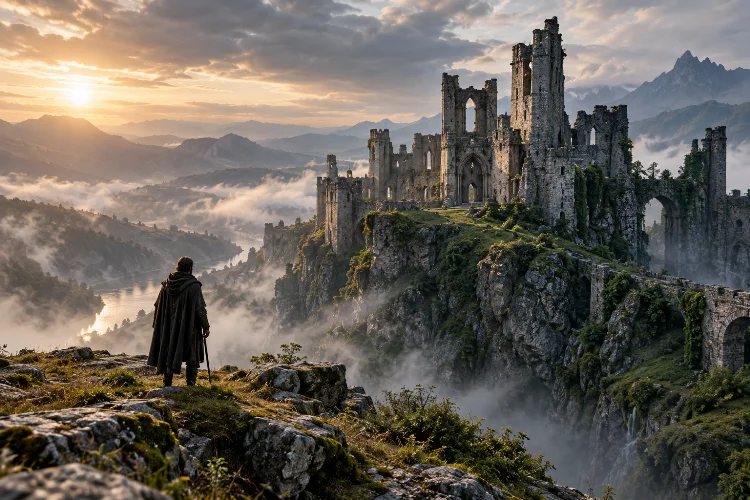
A castle standing proudly above a valley sends one message. The same castle with broken towers, empty windows, collapsed walls, and vegetation growing through its halls sends something completely different.
Dark fantasy understands that difference extremely well. The advanced symbolism of ruins and castles in dark fantasy films goes far beyond creating an impressive backdrop.
These structures can represent dead civilizations, fading aristocracies, corrupted authority, psychological imprisonment, forgotten wars, or memories that refuse to disappear.
Gothic traditions have long connected castles and ancestral mansions with darkness, isolation, violence, and decay.
Cambridge’s overview of Gothic film notes that derelict castles and labyrinthine mansions remain central visual associations of Gothic cinema, continuing traditions established in literature centuries earlier.
Modern fantasy expands that language even further. A ruined fortress can reveal the collapse of an empire, while an enormous intact castle may communicate control and hierarchy.
In either case, architecture tells the audience who once had power – and what happened to it.
Ruins Turn History Into Something Visible
Fantasy movies often contain thousands of years of invented history.
Explaining all of it through dialogue would be exhausting.
Ruins offer a better solution.
A broken bridge, abandoned fortress, or collapsed city immediately suggests that another civilization existed before the current story. The audience does not need to know every king or battle to understand that something important was lost.
Middle-earth provides one of the strongest examples.
Christopher Tolkien described its landscape as particularly rich in ancient roads, ruined cities, old battlefields, and enormous stone works, with references to places that have disappeared entirely from the map.
That gives ruins narrative weight.
Characters are not simply exploring interesting scenery. They are walking through the consequences of earlier ages.
This makes the fantasy world feel older than the plot itself.
Castles Symbolize Concentrated Power
A castle is rarely politically neutral.
Its walls, towers, gates, and elevated position communicate control.
Historically inspired fantasy often uses castles to represent rulers who can protect themselves from the ordinary population while observing the surrounding land from above. Architecture becomes a visual hierarchy.
Height matters.
The ruler occupies the tower. Guards control the gate. Visitors must pass through layers of security before reaching the throne room.
Dark fantasy can make this symbolism more uncomfortable.
A powerful castle may initially appear secure, but that security can resemble imprisonment. The same walls that keep enemies outside can prevent inhabitants from escaping.
The castle therefore carries two meanings at once: protection and confinement.
That contradiction is particularly useful in Gothic storytelling, where powerful families often discover that their grand ancestral homes have become elaborate prisons.
Decaying Castles Represent Power That Can No Longer Sustain Itself
An intact fortress communicates stability.
A ruined one communicates failure.
That is why decaying castles work so well when filmmakers want to portray the collapse of an aristocratic family, monarchy, empire, or supernatural order.
Crimson Peak turns this idea into one of its central visual metaphors.
BFI describes Allerdale Hall as a magnificent ruin where leaves and snow enter through the damaged ceiling, while red clay spreads through the basement and stains the surrounding landscape.
The Sharpe family still behaves as though its name carries significance, but the house reveals something different.
Their world is collapsing.
The building becomes proof that inherited status can survive culturally even after its economic foundation has disappeared.
This is why decay is so effective in dark fantasy.
It shows the gap between how characters imagine themselves and what reality has become.
Ruins Can Symbolize Civilizations That Failed
Dark fantasy frequently uses ruins on a larger scale.
Instead of representing one family, they can represent an entire culture.
A destroyed city may suggest war, magical catastrophe, environmental collapse, or political arrogance. Characters exploring it are effectively studying the consequences of someone else’s choices.
This gives ruins a warning function.
They tell the present generation: another society believed it would survive forever too.
Tolkien’s mythology repeatedly uses this pattern. The Silmarillion describes great strongholds and civilizations that eventually fall through warfare, betrayal, and overwhelming forces, leaving later generations to inhabit a world shaped by their disappearance.
Dark fantasy filmmakers can communicate similar ideas with a single landscape.
A massive ruined city in the distance creates questions immediately.
Who built it?
Why did something so powerful disappear?
And could the same thing happen again?
Castles Create Psychological Isolation
A fantasy castle can be physically enormous while still making characters feel trapped.
Long corridors separate people.
Heavy doors reduce communication. Towers create distance. Underground chambers remove characters from sunlight and ordinary life.
This turns architecture into psychological pressure.
The classic Gothic castle is especially effective because it is usually difficult to understand completely. Staircases lead to unfamiliar floors. Locked rooms suggest secrets. Corridors turn unexpectedly.
The person living inside may know the building better than the protagonist.
That creates a power imbalance.
Jean Cocteau’s La Belle et la Bête offers a more dreamlike version of the idea. BFI describes its enchanted castle as filled with living statues, magical décor, shadow-filled spaces, and a strongly Gothic atmosphere.
The castle separates Beauty from normal reality.
Entering it means crossing into another emotional and supernatural system.
Dark fantasy frequently uses castles in exactly this way: once the gate closes, ordinary rules no longer seem completely reliable.
Underground Ruins Represent Buried Memory
Fantasy architecture becomes especially symbolic when characters move downward.
Cellars, crypts, tunnels, forgotten temples, and buried cities often contain things society has chosen not to remember.
The symbolism is almost instinctive.
The surface represents the visible present.
Underground spaces represent the hidden past.
A protagonist descending into an ancient crypt may therefore be doing much more than exploring. They are moving backward through history.
Bones, inscriptions, abandoned weapons, statues, and sealed doors can reveal evidence that official versions of the past have ignored.
This technique also makes exposition more engaging.
Instead of hearing someone explain an ancient disaster, characters discover its remains.
The audience experiences history as investigation.
That is much more powerful than a lecture because every new chamber can change what the protagonist believes.
In dark fantasy, knowledge is often physically buried for a reason.
Someone wanted it forgotten.
Nature Reclaiming Ruins Shows the Limits of Human Control
Few fantasy images are more evocative than trees growing through abandoned stone.
Nature reclaiming architecture represents time on a scale much larger than human ambition.
A king may build walls believing they will last forever.
Centuries later, roots split those walls apart.
This creates a subtle challenge to political power.
Castles, monuments, and fortresses are built to communicate permanence. Vegetation covering them proves that permanence was an illusion.
This imagery can also suggest healing.
Not every ruin needs to represent pure destruction. Sometimes a collapsed civilization allows the natural world to return.
That creates an interesting contrast between human memory and ecological time.
From the character’s perspective, the place may represent tragedy.
From nature’s perspective, it may simply be another landscape changing.
Dark fantasy becomes especially rich when these meanings coexist rather than producing one simple interpretation.
Ruins Create the Feeling of a Larger Unseen World
One of the most valuable functions of ruins is what they do not explain.
Imagine characters passing an enormous broken statue beside a road.
Nobody discusses it.
The audience immediately begins wondering who the statue represented and why it fell.
That unanswered question makes the fictional world larger.
Tolkien’s legendarium is particularly effective because its stories frequently contain glimpses of older ages without explaining every detail inside the immediate narrative.
The larger History of Middle-earth demonstrates how extensively those backgrounds developed behind the better-known stories.
Filmmakers do not need Tolkien-level documentation to create the same effect.
They simply need restraint.
Not every castle needs an origin story.
Not every abandoned city needs a flashback.
Sometimes an unexplained ruin creates more depth because it implies that the world contains histories irrelevant to the protagonist’s current mission.
Real places work that way too.
The world does not exist solely for the main character.
Castles Can Represent Desire as Well as Fear
Dark fantasy castles are not always places audiences want to escape.
Sometimes they are seductive.
They contain beautiful halls, enormous libraries, forbidden knowledge, luxury, magical objects, or mysterious inhabitants.
That attraction matters.
A castle becomes more interesting when the protagonist wants something inside it.
The setting then produces both desire and anxiety.
Les visiteurs du soir, for example, places supernatural disruption inside an elegant medieval castle during court festivities, allowing romance, temptation, supernatural influence, and political space to overlap.
This duality appears throughout Gothic fantasy.
The castle promises protection but threatens imprisonment.
It offers wealth but hides corruption.
It looks beautiful but carries violent history.
That contradiction prevents architecture from becoming simply “scary.”
The most memorable dark fantasy locations attract audiences at the same time they make them uncomfortable.
Ruins Often Turn Victory Into Melancholy
Fantasy stories regularly end with evil defeated.
But ruins remind audiences that victory does not restore everything.
Destroyed cities may remain destroyed.
Ancient peoples do not automatically return. Lost knowledge stays lost. Characters who survived may still inhabit a world permanently changed by conflict.
Ruins therefore complicate triumph.
They represent survival with consequences.
This is particularly important in epic fantasy, where defeating one enemy can still mean witnessing the end of an entire historical age.
Middle-earth repeatedly carries this feeling of decline. Its present exists among the remains and memories of older, sometimes greater civilizations, making the world feel beautiful partly because so much has already been lost.
That sense of loss creates melancholly.
The heroes may save what remains.
They cannot bring every vanished world back.
Dark fantasy uses ruins to make that limitation visible.
The symbolism of ruins and castles in dark fantasy films reaches far beyond Gothic decoration. Castles can represent concentrated power, protection, confinement, temptation, and inherited authority, while ruins expose the fragility of those same ideas.
Collapsed cities turn history into physical evidence. Underground chambers preserve forgotten memory, and nature reclaiming architecture reminds viewers that even seemingly permanent civilizations eventually change.
That is why these locations remain so powerful.
Next time a dark fantasy movie introduces a ruined fortress or enormous castle, look beyond its visual design. Ask who built it, what kind of power it once represented, what caused its decline, and why the story brings its characters there.
The stones are rarely just scenery.
They are usually telling another story underneath the main one.
