

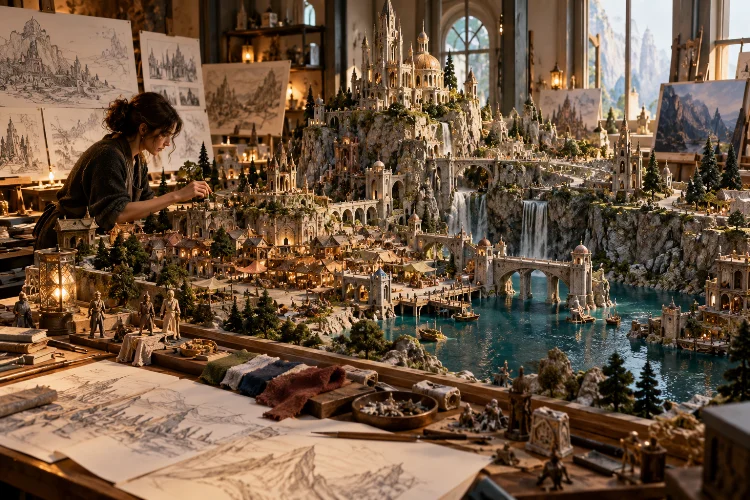
The best fantasy movies can make an impossible place feel strangely real.
Within minutes, audiences may accept cities carved into mountains, ancient magical orders, invented religions, talking creatures, mysterious currencies, or political conflicts between kingdoms that never existed.
That feeling does not come from visual effects alone.
Understanding advanced worldbuilding techniques behind immersive fantasy movies means looking at how filmmakers connect geography, history, culture, architecture, costumes, sound, language, politics, and supernatural rules into one believable system.
The strongest fictional worlds rarely explain everything directly. Instead, audiences discover them through environments, character behavior, rituals, objects, conflicts, and small details that suggest a much larger reality beyond the frame.
Middle-earth, Arrakis, Oz, and the spirit world of Spirited Away are memorable because they appear to continue existing even when the main characters are not present.
That is the real goal of cinematic worldbuilding: not simply creating a beautiful setting, but creating the illusion that the world has a past, a present, and a future of its own.
Build a World Around Internal Consistency
A fantasy world does not need to follow the rules of reality.
It does need to follow its own rules.
Audiences will usually accept dragons, magic, immortal beings, or impossible landscapes if the fictional world establishes clear expectations and remains reasonably consistant with them.
This is closely connected to J.R.R. Tolkien’s idea of the “Secondary World.” Tolkien described fantasy as a form of sub-creation in which writers construct an imagined reality capable of sustaining belief while the audience is inside it.
Consistency creates trust.
If magic has limitations in one scene, those limits should not disappear simply because the protagonist needs an easy solution later.
If traveling between two kingdoms takes several weeks early in the movie, characters should not suddenly cross the same distance overnight without explanation.
Small contradictions can quietly break immersion.
Geography Should Influence the Story
Fantasy maps are not just decorative.
Geography should influence trade, warfare, food, clothing, architecture, transportation, and even political relationships.
A civilization living in a desert should develop differently from one surrounded by forests or oceans. Water scarcity might influence religion and social hierarchy. Mountain barriers could isolate cultures and create distinct languages or customs.
Dune demonstrates this particularly well.
Arrakis is not simply a desert backdrop. The extreme environment shapes Fremen clothing, technology, movement, architecture, survival strategies, and beliefs. Water becomes economically and culturally significant because the environment makes it scarce.
This creates what could be called environmental causality.
The landscape produces consequences.
When geography affects character behavior, it stops looking like a digital background and starts feeling like an actual place.
Production Design Should Tell Stories Without Dialogue
Some of the strongest worldbuilding happens before anybody speaks.
Buildings, furniture, weapons, vehicles, clothing, and public spaces reveal information about wealth, technology, religion, history, and social hierarchy.
A palace built from polished stone creates a different impression from one constructed inside an ancient tree. A city filled with repaired buildings suggests a history of destruction. Worn objects imply generations of use.
Production design therefore becomes a form of visual exposition.
BAFTA describes production design teams as responsible for creating the visual environments that draw audiences into the worlds inhabited by film characters.
Dune offers a useful example of this principle. Its enormous architecture makes human characters appear physically small, reinforcing themes of empire, institutions, power, and inherited authority.
The production design of the first Dune also won the Academy Award in 2022.
Good fantasy design does not merely look impressive.
It communicates information.
Create Cultures, Not Just Costumes
One common worldbuilding mistake is treating culture as visual styling.
A fictional society gets unusual clothes, interesting hairstyles, and impressive architecture, but its people otherwise behave exactly like modern humans from the same cultural background as the filmmaker.
Deeper worldbuilding asks more questions.
What does this society consider polite? How are children raised? What happens when someone dies? Who inherits property? Which professions have high status? What foods are associated with celebrations? What behavior causes shame?
These details create cultural logic.
The audience does not need to receive all the answers directly. In fact, explaining every custom would probably make the movie exhausting.
Instead, filmmakers can show rituals naturally.
A character might remove their shoes before entering a sacred building. Soldiers may perform a gesture before combat. Families might eat according to a particular hierarchy.
Small repeated behaviors make fictional cultures feel beliveable.
Give the World a History That Leaves Visible Scars
One of the fastest ways to make a fantasy world feel shallow is to make everything appear newly created for the protagonist.
Real societies exist on top of previous societies.
Fantasy worlds should feel similar.
Ruined temples, abandoned roads, old battlefields, inherited prejudices, forgotten languages, disputed borders, and ancient monuments can suggest events that occurred centuries before the current story.
Tolkien developed Middle-earth through interconnected legends extending from cosmic creation stories to smaller individual adventures.
His broader legendarium gave The Hobbit and The Lord of the Rings what Tolkien scholar David Bratman describes as enormous historical “backcloths.”
Not every filmmaker needs thousands of pages of fictional history.
The important principle is consequence.
If an ancient war supposedly transformed the world, audiences should see evidence of that transformation somewhere in the present.
History becomes convincing when characters still live with its results.
Design Magic as Part of Society
Magic should change more than battle scenes.
If supernatural abilities genuinely exist, people would probably build institutions, laws, professions, fears, religions, and technologies around them.
That is where advanced worldbuilding becomes interesting.
Imagine a society where magical healing is common. Traditional medicine, warfare, life expectancy, insurance, and attitudes toward physical risk could all develop differently.
If teleportation exists, transportation networks might change completely.
If only one social class can use magic, supernatural ability could become a political resource.
This does not mean every fantasy film needs a complicated “hard magic” system with mathematical rules. Softer magical worlds can remain mysterious.
But the supernatural should still influence the surrounding society.
Magic feels integrated when characters treat it as part of their reality rather than as a special effect waiting for the next action sequence.
Language and Naming Create Cultural Depth
Audiences may never become fluent in a fictional language, but language can dramatically strengthen worldbuilding.
Names establish patterns.
If every person from one kingdom follows similar linguistic conventions, audiences unconsciously begin recognizing cultural boundaries.
Tolkien understood this unusually well because he was a professional philologist as well as a fantasy writer. The Tolkien Estate notes that his creative work included invented languages and alphabets alongside the development of Middle-earth.
Modern fantasy films can use similar principles without inventing complete languages.
Repeated sounds, titles, honorifics, religious terms, regional accents, and naming traditions can all suggest linguistic history.
The important part is coherence.
Random complicated names do not automatically create depth. They can actually make the world harder to follow.
Language works best when it reflects culture rather than simply making things sound exotic.
Use Environmental Storytelling Instead of Exposition
Fantasy movies often have enormous amounts of information to communicate.
The temptation is to explain everything through dialogue.
A mentor tells the protagonist the history of the kingdom. Another character explains the magical system. Someone else describes the ancient war.
Too much of this creates exposition fatigue.
Environmental storytelling offers a more elegant solution.
A damaged statue can show that a former ruler has fallen from favor. Different religious symbols inside one city may reveal cultural mixing. Guarded wells can demonstrate water scarcity without anyone explaining it.
This technique allows viewers to become active participants.
They infer information.
The world feels deeper precisely because the movie does not explain every detail.
A good rule is simple: if information can be communicated through behavior, architecture, costume, or environment, dialogue may not be necessary.
Let Different Regions Feel Genuinely Different
Large fantasy worlds often contain multiple kingdoms, but sometimes those kingdoms feel like the same place with different banners.
Advanced world design creates meaningful regional variation.
Climate affects materials. Materials influence architechture. Geography shapes economies. Economies influence political power. Historical contact influences language and religion.
Everything connects.
Middle-earth works partly because the Shire, Rivendell, Rohan, Gondor, Mordor, and Moria have distinctly different visual and cultural identities.
Tolkien scholarship emphasizes that Middle-earth combines familiar landscapes with ancient and extraordinary peoples while maintaining its own self-contained history.
Visual difference alone is not enough.
Ideally, audiences should understand something about a society simply from seeing how people live there.
Sound Is Part of Worldbuilding Too
Fantasy worlds are not experienced only through images.
Sound plays a huge role in making them feel physical.
Different environments can contain distinct ambient sounds. Languages have unique rhythms. Machinery, animals, weapons, religious ceremonies, and magical phenomena can all have recognizable sonic identities.
Music can reinforce cultural distinctions as well.
A particular instrument or musical texture associated with one region helps audiences understand transitions even before the new location is fully revealed.
The success of Dune illustrates how multiple filmmaking departments can combine to create immersion. At the 2022 Academy Awards, the film won not only Production Design but also Sound and Visual Effects, among other categories.
Immersive worldbuilding is therefore rarely the achievement of one department.
It emerges when image, sound, performance, costume, architecture, and narrative all describe the same fictional reality.
Leave Some Parts of the World Unexplained
Detailed worldbuilding does not mean explaining everything.
Mystery creates scale.
When characters mention distant countries, forgotten civilizations, unexplored regions, or old legends without immediately visiting or explaining them, the audience begins imagining a world beyond the boundaries of the movie.
That invisible space is powerful.
Tolkien’s Middle-earth became especially effective because larger histories existed behind relatively small adventures. The audience could sense that Bilbo’s journey was happening inside a much older and larger world.
Modern fantasy filmmakers can achieve something similar through restraint.
Not every ruined tower needs a flashback.
Not every god needs an origin story.
Sometimes the suggestion that more exists is more immersive than a complete explanation.
Advanced worldbuilding is not about filling a fantasy movie with endless lore. It is about creating connections.
Geography should influence culture. History should leave scars. Magic should affect society. Architecture should reveal power, while language, costume, sound, and everyday behavior should reinforce the same fictional logic.
The most immersive worlds also know when to remain mysterious. They reveal enough detail to feel coherent while leaving unexplored spaces that encourage audiences to imagine what lies beyond the story.
Next time you watch a fantasy movie, look beyond the castles, creatures, and visual effects. Pay attention to how people eat, travel, worship, build, speak, and remember their past.
Those smaller details are often what transform an invented setting into a world that feels alive.
