

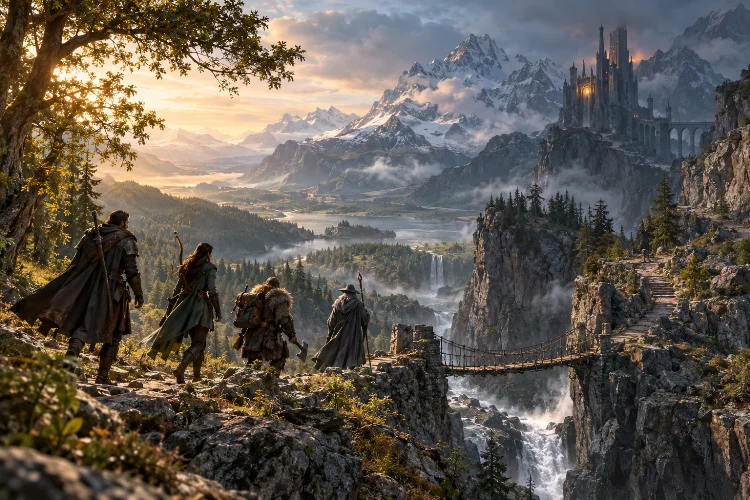
A fantasy quest sounds simple on paper: somebody needs to leave home, travel somewhere dangerous, overcome a series of obstacles, and accomplish an important goal.
Yet that basic structure has supported everything from small fairy tales to enormous cinematic worlds filled with kingdoms, monsters, political conflicts, magical systems, and competing destinies.
The reason is flexibility.
Understanding advanced quest narratives and their role in fantasy film design means looking at the journey as more than a chain of adventures. In strong fantasy movies, the quest becomes an organizing system.
It determines when new parts of the world are revealed, how characters develop, when danger escalates, and how information reaches the audience.
Films such as The Lord of the Rings, The Green Knight, Spirited Away, and Dune demonstrate that two quests can share familiar ingredients while producing completely different experiences.
The destination matters, but the real design challenge lies in what happens between departure and arrival – and how every stage changes the characters who keep moving forward.
The Quest Gives a Fantasy World Direction
Fantasy settings can easily become overwhelming.
A filmmaker may have centuries of fictional history, multiple cultures, complex religions, magical rules, political rivalries, and dozens of locations to introduce. Showing all of that at once would turn the movie into an encyclopedia.
The quest provides a solution.
Instead of presenting the entire fictional universe immediately, the story reveals it as the protagonists travel through it. A new kingdom appears because the characters need to cross it.
A magical tradition becomes relevant because someone must interact with it. Political tensions matter because they create obstacles along the route.
The Cambridge Companion to Fantasy Literature describes quest fantasy as a stepped journey in which confrontations usually become increasingly dangerous while smaller quests may develop inside the main journey.
This structure makes worldbuilding feel functional rather than decorative.
The audience learns the world because the characters need to survive inside it.
A Strong Quest Usually Starts With Stability and Disruption
Quest narratives often begin somewhere relatively safe.
The protagonist may live in a village, family home, peaceful kingdom, ordinary city, or protected community. The opening establishes what “normal” looks like before something breaks that stability.
Then comes disruption.
An enemy arrives. An object must be destroyed. Someone disappears. A kingdom becomes threatened. The protagonist discovers information that makes remaining at home impossible.
This transition is important because adventure only feels meaningful when audiences understand what has been left behind.
The Fellowship of the Ring offers one of the clearest examples. Frodo begins in the Shire, a deliberately comfortable environment far removed from Sauron’s war. His mission to destroy the Ring gradually pulls him through increasingly hostile spaces.
The BFI describes the film around the quest of a mixed group of characters attempting to destroy the Ring before Sauron can claim it.
The distance between the Shire and Mordor is therefore geographical, emotional, and moral.
Obstacles Should Transform the Quest, Not Delay It
A weak quest can feel like a video game with repetitive levels.
The hero reaches an obstacle, defeats it, walks farther, encounters another enemy, wins again, and eventually reaches the destination.
Strong quest design works differently.
Every major obstacle should alter something.
Perhaps the group loses a member. An ally becomes unreliable. The protagonist discovers uncomfortable information. A magical object creates new problems. A shortcut produces unexpected consequences.
The challenge changes the narative situation.
Vladimir Propp’s analysis of folktales is useful here. His Morphology of the Folktale examined recurring narrative functions such as departure, testing, receiving assistance, struggle, pursuit, difficult tasks, recognition, and return.
Modern movies do not need to follow those functions mechanically.
The useful principle is simpler: obstacles should perform a function.
If removing an entire sequence would change nothing about the character, relationships, world, or final outcome, the sequence may simply be delaying the destination.
The Physical Journey Can Mirror Character Transformation
One reason quests remain powerful is that they turn internal change into visible movement.
Characters literally leave one place and become different people before reaching another.
Joseph Campbell’s monomyth famously describes heroic stories through a broad movement of separation, initiation, and return. Contemporary explanations of the model also warn against reducing it to a rigid checklist of compulsory screenplay beats.
That distinction matters.
The interesting question is not whether every fantasy protagonist encounters exactly the same stages. It is whether the journey creates transformation.
Consider The Green Knight. Gawain travels toward an apparently straightforward appointment with the Green Knight, but the physical destination is almost secondary.
The encounters along the road test courage, honesty, sexuality, selfishness, mortality, and Gawain’s desire to become legendary.
The quest gradually exposes the difference between wanting the reputation of a hero and actually developing heroic character.
That is sophisticated quest design: geography becomes psychology.
Companions Turn Quests Into Relationship Engines
A quest becomes even more useful when several characters travel together.
Putting people on the road removes many forms of escape.
Characters have to share limited resources, make decisions under pressure, deal with conflicting values, and depend on people they may not completely trust.
That naturally generates drama.
The Fellowship in The Lord of the Rings works because its members represent different cultures, loyalties, abilities, and historical tensions. The journey forces those differences into constant contact.
Friendships develop, suspicion grows, alliances change, and sacrifice becomes more meaningful because relationships have had time to evolve.
Peter Jackson’s adaptation also streamlined Tolkien’s material while keeping the central odyssey and progressively dangerous movement through Middle-earth intact.
This is why travel scenes do not have to be empty transitions.
A well-designed quest uses movement to develop relationships at the same time it advances the plot.
The Best Quests Escalate in More Than Physical Danger
Escalation is essential to fantasy adventures.
Early problems may involve escaping a small group of enemies. Later problems can involve armies, ancient creatures, collapsing kingdoms, or supernatural forces.
But increasing physical danger alone eventually becomes predictable.
Better quests escalate emotionally and ethically too.
The protagonist may initially ask, “Can I survive this?”
Later, the question becomes, “What am I willing to sacrifice?”
Eventually it may become, “Should I even complete the mission?”
That final question is particularly powerful because it challenges the premise of the quest itself.
If the hero learns something that makes the original goal morally questionable, the audience must reassess the entire journey.
This approach prevents escalation from becoming nothing more than bigger battles and louder visual effects.
Danger gets larger, but so does meaning.
Side Quests Can Expand the Story Without Breaking It
Epic fantasy often begins with one central journey and gradually separates into multiple routes.
This can make the fictional world feel enormous.
The Cambridge discussion of quest fantasy specifically notes that an initially unified narrative may become more complex as individuals or smaller groups pursue secondary quests within the larger structure.
The Lord of the Rings demonstrates this clearly after the Fellowship breaks apart.
Frodo and Sam continue toward Mordor. Aragorn, Legolas, and Gimli follow another path. Merry and Pippin become involved with different characters and political events.
The danger is fragmentation.
Every secondary journey needs some relationship with the central conflict. Otherwise, the audience starts wondering why they are watching it.
Strong side quests usually contribute information, allies, emotional development, political change, or resources that eventually influence the main outcome.
They make the world larger without making the story feel directionless.
Quest Design Controls Pacing Through Alternating Pressure
Travel naturally creates rhythm.
Characters encounter danger, escape it, recover, talk, travel again, discover something new, and eventually face another challenge.
That pattern allows filmmakers to alternate pressure and relief.
Constant combat can exhaust audiences. Constant conversation can drain momentum. Quest structures naturally create space for both.
A terrifying underground sequence can be followed by a quiet scene around a fire. A major victory can lead to a period of uncertainty rather than another immediate fight.
These quieter moments are especially useful for revealing character.
They give people time to process losses, question decisions, or discuss why they are still continuing.
Pacing therefore becomes connected to geography.
Mountains can slow the journey. Open plains can create vulnerability. A forest may introduce uncertainty. A fortress creates temporary security – or the illusion of it.
The enviroment becomes part of the editing rhythm.
Reaching the Destination Should Change the Meaning of the Quest
The weakest possible ending is simply arriving.
A quest needs payoff.
Ideally, reaching the destination reveals that the story was never only about reaching it.
Frodo’s journey to Mount Doom is not merely a delivery mission. By the end, the Ring has transformed his relationship with power, friendship, home, and himself.
The journey leaves consequences.
This is why effective fantasy quests frequently complicate victory.
The world may be saved, but a companion is gone. The hero returns home, but home no longer feels the same. The magical object is destroyed, but an era ends with it.
A strong ending looks backward as much as forward.
Every earlier obstacle, choice, relationship, and sacrifice should make the destination emotionally different from what the protagonist imagined at the beginning.
That creates transformaton rather than simple completion.
Quest Narratives Also Reveal What a Story Values
Every quest has an object, destination, or goal.
But what the movie ultimately rewards tells us what the story considers important.
Does the protagonist succeed through physical strength, compassion, loyalty, cleverness, sacrifice, obedience, or refusal?
That distinction matters.
Two films can use nearly identical quest structures while expressing completely different ideas about heroism.
Recent research applying Propp’s framework to films such as Frozen and Brave shows how contemporary fantasy can retain traditional functions while modifying their form and meaning.
Modern quest narratives are therefore not simply recycled folktales.
They are adaptable structures.
Filmmakers can keep departure, testing, helpers, obstacles, and return while changing who gets to be heroic and what successful completion actually means.
That flexibility explains why the quest remains one of fantasy cinema’s most durable storytelling tools.
Advanced quest narratives are not just about sending heroes across maps. They provide fantasy filmmakers with a flexible system for controlling worldbuilding, pacing, character development, escalation, relationships, and emotional payoff.
The strongest quests reveal fictional worlds gradually, give every obstacle a narrative purpose, and allow physical movement to reflect psychological change.
Side journeys can expand the scale, while companions turn travel into a source of constant interpersonal conflict and growth.
Most importantly, the destination should never be the only thing that matters.
When watching your next fantasy film, pay attention to what each stage of the journey changes. Ask why a particular obstacle exists, what the hero learns from it, and whether reaching the destination means what they originally thought it would.
That is where quest design becomes real storytelling.
