

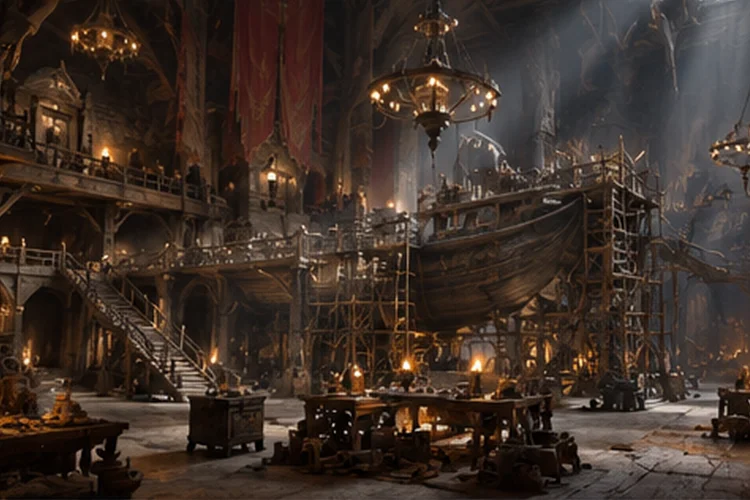
A fantasy environment can look spectacular in a single screenshot and still feel strangely empty once characters begin moving through it.
Beautiful architecture alone is not enough. The audience needs to believe that people could actually sleep, work, fight, celebrate, worship, and get lost inside the space.
That is where advanced set design for immersive fantasy film environments becomes important.
Great fantasy sets combine architecture, practical construction, materials, props, lighting, scale, cultural research, and digital extensions into a coherent physical experience. A palace should reveal political hierarchy through its layout.
A desert fortress should respond to heat and wind. Even small objects on a table can suggest how a fictional society eats, trades, or manufactures everyday goods.
Films such as Dune, Black Panther, and The Lord of the Rings demonstrate different approaches to this challenge.
The strongest sets do more than provide backgrounds.
They give performers spaces to inhabit and give audiences the feeling that another world continues beyond the edge of the frame.
Design the Space Around Character Movement
A set should be designed for action, not simply for appearance.
Characters need believable routes through rooms, streets, staircases, courtyards, and corridors. Where they enter, where they stop, and how close they can get to other characters all influence the emotional rhythm of a scene.
A massive throne room, for example, can create distance between a ruler and everyone approaching them.
A narrow corridor does the opposite. It forces characters together and can make even an ordinary conversation feel uncomfortable.
This is why floor plans matter.
Production designers and directors need to consider blocking, camera movement, entrances, exits, and sightlines before construction begins.
A visually impressive set becomes much more valuable when its geography generates storytelling possibilities.
Fantasy spaces should feel like places characters could navigate even when the camera is not watching them.
Practical Construction Creates Physical Believability
Digital environments can create enormous worlds, but physical sets still offer something extremely valuable: resistance.
Actors can touch walls, open doors, lean against furniture, and physically judge the distance between themselves and other objects.
Light also behaves naturally across real materials.
For Dune, production designer Patrice Vermette emphasized physically constructed environments wherever practical, with major sets built at studios and combined with real locations in places including Jordan, Norway, and Abu Dhabi.
Arrakeen’s structures were designed around real environmental logic, including heat and powerful desert winds.
This does not mean practical sets are automatically better than VFX.
The strongest approach is often hybrid.
Build what performers and cameras need to interact with, then extend the environment digitally when scale becomes impossible or unnecessarily expensive.
The result preserves physical detail while still allowing fantasy to become enormous.
Material Texture Makes a World Feel Touchable
Set design becomes immersive when audiences can almost imagine how a surface would feel.
Rough stone, polished metal, aged timber, woven fabric, cracked plaster, ceramic tile, and carved wood all communicate different things about a culture.
Materials also reveal resources and technology.
A society surrounded by forests may use timber extensively. A civilization with sophisticated metalworking might integrate metal into doors, tools, furniture, and architecture rather than reserving it only for weapons.
Texture becomes especially important in fantasy because environments can otherwise look too clean.
Real places accumulate scratches, stains, repairs, dust, weathering, and uneven surfaces.
Those imperfections create history.
A perfectly symmetrical stone hallway might look beautiful, but one with repaired flooring and worn steps suggests generations of people actually walked through it.
That slightly messier reality often produces stronger imersion.
Use Scale to Shape Emotion
Fantasy movies frequently involve enormous spaces, but size should have a purpose.
A huge hall can communicate authority.
A tiny room inside a giant palace might create secrecy. An underground chamber can make characters feel buried beneath the civilisation above them.
Dune repeatedly uses monumental architecture to make human figures appear small compared with political institutions and hostile environments.
The film’s production design received the Academy Award in 2022, reflecting how important those environments were to its overall visual storytelling.
Scale can also work through contrast.
If every space is enormous, audiences quickly become accustomed to it.
Moving from a giant ceremonial hall into a cramped private room can suddenly reveal the vulnerable person behind the powerful ruler.
That contrast gives scale narrative meaning.
Fantasy set design becomes more sophisticated when size changes according to what the scene needs the audience to feel.
Build Cultural Identity Into the Environment
A fictional civilisation should not look like a collection of unrelated cool ideas.
Its buildings, furniture, symbols, technology, clothing, and decorative patterns should share some visual logic.
Black Panther demonstrates this clearly.
Production designer Hannah Beachler researched architecture from multiple parts of Africa as well as modern architects such as Zaha Hadid.
Wakanda was designed as a technologically advanced society that had retained strong connections to tradition rather than replacing its cultural past with generic futurism.
That cultural coherence also extended into costume.
Marvel’s behind-the-scenes material explains that Ruth Carter coordinated costume colors and cultural references with the larger visual design of Wakanda, helping distinct groups feel different while remaining part of the same nation.
This is a useful lesson for set designers.
Repeating shapes, materials, colors, and motifs creates recognition.
The audience begins understanding where they are before any character announces the location.
Props Should Explain How People Live
Immersive sets are not only walls and floors.
Small objects often do some of the most important worldbuilding.
What does a family eat from? What kind of lamp do they use? How are documents stored? What does a soldier carry when they are off duty?
These details reveal ordinary life.
Wētā Workshop’s work on The Lord of the Rings extended far beyond large landscapes. The studio designed and manufactured weapons, armor, costumes, prosthetics, miniatures, and countless other physical pieces that helped give Middle-earth a consistent material identity.
That consistency matters.
A sword should feel as though it came from the same culture that built the fortress where its owner lives.
A royal cup, chair, shield, and doorway can share decorative ideas without looking identical.
When props follow the same visual rules as the environment, audiences begin treating the fictional culture as a coherent manufacturing society rather than a series of disconnected sets.
Design Lighting Into the Set From the Beginning
Lighting should not be an afterthought.
Windows, doorways, skylights, fires, lamps, reflective materials, and architectural openings all determine what cinematographers can do with a space.
A fantasy temple illuminated through narrow shafts of sunlight feels different from the same room filled with evenly distributed modern lighting.
Set designers therefore need to consider natural and artificial light sources while shaping architecture.
Materials matter here too.
Polished metal reflects light differently from rough stone. Dark wood absorbs it. Pale walls spread illumination across the room.
This relationship can influence atmosphere before color grading or visual effects are added.
A well-designed environment practically helps light itself.
The set tells the cinematographer where shadows should fall and where attention should naturally go.
That collaboration turns visual design into narative design rather than simple decoration.
Practical Sets and VFX Must Share the Same Rules
Fantasy environments often become too large to construct completely.
A fortress may need thousands of towers. A city can stretch to the horizon. An underground kingdom might be several kilometers wide.
Digital extensions solve that problem, but they work best when they continue the logic established by the physical set.
Wētā Workshop describes its own pipeline as connecting design, manufacture, set pieces, and VFX-oriented worldbuilding rather than treating them as completely separate processes.
That integration prevents the digital background from feeling like another world pasted behind the actors.
The same materials, proportions, motifs, weathering, and architectural rules should continue beyond the physical construction.
Even impossible spaces benefit from believable repetition.
If the real doorway has one construction logic but the digital towers use an entirely unrelated style, viewers may not know exactly what is wrong, but the illusion weakens.
Coherence matters more than technical complexity.
Sets Need Signs of Everyday Use
One of the fastest ways to make fantasy environments feel artificial is to make them look untouched.
People leave traces.
Floors wear down where traffic is heaviest. Furniture moves. Tools remain on workbenches. Market stalls accumulate clutter. Walls get repaired.
Set dressing should reflect those patterns.
A military barracks should look different from a ceremonial chamber even if both belong to the same kingdom.
A wealthy household may own beautiful objects, but servants still need practical workspaces.
These smaller signs make a fantasy environment feel inhabited rather than presented.
Wētā Workshop’s description of its Middle-earth work emphasizes the huge quantity of physical items manufactured for entire populations and armies, illustrating how worldbuilding depends on volume as well as individual hero props.
This is especially important for epic fantasy.
A civilisation should look as though thousands of ordinary people exist beyond the protagonists.
Environmental Damage Can Tell Backstory
Sets can explain history through damage.
A wall repaired with different stone suggests an earlier attack. Burn marks imply fire or warfare. A blocked doorway may indicate that the building changed function over time.
These details replace exposition with evidence.
Instead of having someone say, “This fortress survived three wars,” production design can make audiences believe it.
Damage also creates chronological layers.
Older structures may have new additions. Modern technology can be attached to ancient architecture. A conquered city might contain symbols from both the original population and its new rulers.
This makes environments feel historically complexx.
Fantasy worlds become much more convincing when they look as though people have continuously adapted them rather than constructing everything immediately before filming began.
The set becomes an archive.
Characters move through history simply by walking from one room to another.
Advanced set design for immersive fantasy film environments is ultimately about making imaginary space behave like real space.
Practical construction gives performers something physical to inhabit, while materials and weathering create texture.
Scale shapes emotion, props reveal everyday life, lighting influences atmosphere, and VFX extensions allow the world to continue beyond what can physically be built.
Films such as Dune, Black Panther, and The Lord of the Rings show that successful fantasy environments are designed as connected systems rather than isolated spectacular images.
Next time you watch an epic fantasy movie, study the background for a moment. Look at worn floors, furniture placement, doorways, materials, lighting, and everyday objects.
The best sets do not simply tell you where the characters are.
They quietly explain how an entire world lives.
